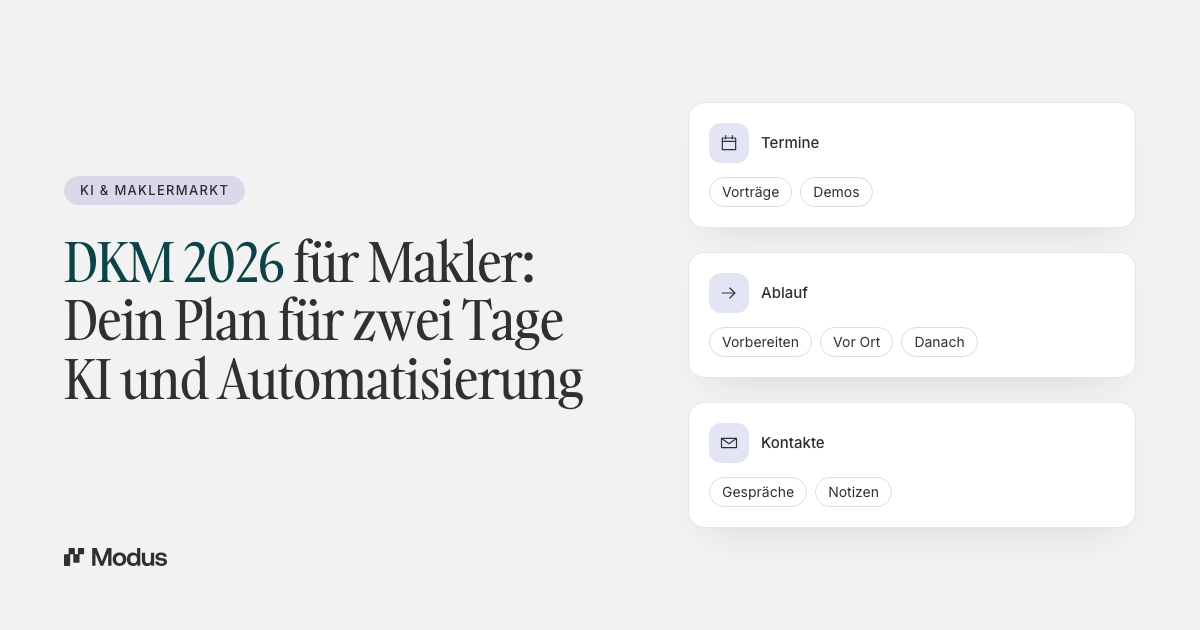
The difference between an AI feature and AI infrastructure
Every tool promises AI today, yet the workload doesn't shrink. The reason is the difference between an AI feature, which speeds up a single step, and AI infrastructure, which changes how work comes into being. With evidence from BAIR, a16z, McKinsey and BCG.
By Daniel D.
Modus
Last updated: Jun 5, 2026
News & InsightsYour brokerage has geared up. The chatbot on the website answers the first questions, one tool summarises emails, another extracts documents, and the management system has had an AI function since the last update. On paper, you're digitally equipped. And yet the inbox on Friday afternoon is just as full as before, and hardly a single case runs noticeably faster. Why is that?
The answer lies in a distinction almost no one in the industry talks about: the difference between an AI feature and AI infrastructure. Both carry AI in the name. But they solve different problems, and only one of them changes how your business actually works.
Every tool promises AI, yet the work doesn't get less
The first reaction to operational overload is almost always the same: another tool. There's now a dedicated application for every task, and each of them has an AI function by now. The result isn't leverage but sprawl.
The figures from the software world are clear. According to Zylo's SaaS Management Index, companies use, on average, only 49 percent of the licences they pay for. A typical portfolio holds 15 different training tools, 11 task-management programs and 10 collaboration platforms side by side. BetterCloud counts an average of around 106 applications per company.
In the brokerage this looks smaller but structurally the same. One tool for emails, one for documents, one for comparison calculations, plus the management system and the website chatbot. Each sensible on its own. Together they don't add up to a system but to a collection of isolated solutions, between which a human carries the data back and forth. Every new AI function is then just another login that doesn't touch the actual problem. More than a third of these applications aren't officially assigned to anyone, either, meaning shadow IT that no one controls. The backlog this creates is no accident but one of the structural capacity traps of growing brokerages.
What an AI feature is: speeding up a single step
An AI feature is a function that makes a single step of the work faster. The chatbot answers the first question. The summariser shortens a long email. Document recognition extracts a policy. The writing assistant drafts a reply.
That's useful, and none of it is wrong. But a feature has a built-in limit: it sits on top of the existing process without changing it. The case as a whole stays in human hands. The AI speeds up one link in the chain, the human still holds every other link.
This is exactly what Forrester describes as the structural weakness of isolated applications: functionally separate software can't deliver the end-to-end connection a business actually needs. If you have ten steps and automate one of them, you still have nine manual steps. The time saving is real but small, and it disappears in the back-and-forth between the tools.
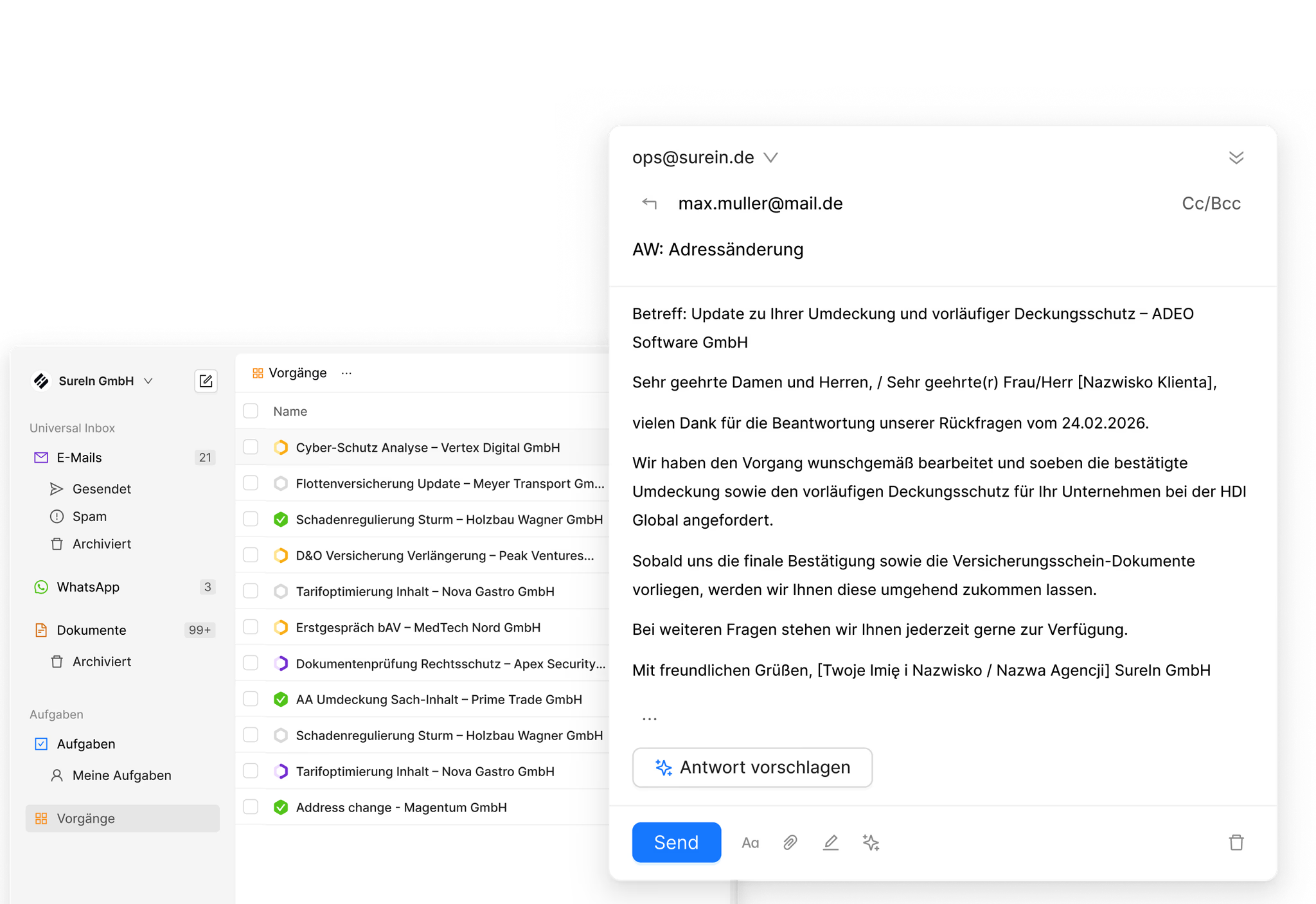
An example: your writing assistant drafts a good reply to a client email in seconds. But someone still has to open the email, find the client in the system, create the case, insert the reply, send it and document it. The feature has taken over one of six steps. The other five stay manual.
What AI infrastructure is: the operational layer that generates work
AI infrastructure operates one layer deeper. It doesn't speed up a step; it changes how work comes into being in the first place. It takes in incoming communication from all channels, recognises the case type, turns it into a structured case with an owner, priority and traceability, and carries the workflow through to a prepared reply. The human reviews and signs off. The system carries the case.
The difference is the same as between a single app and the operating system beneath it. The app handles one task. The operating system coordinates everything. That's why we talk about AI infrastructure or an operational operating system, not another tool. In practical terms: email, WhatsApp, a BiPRO document and a phone note don't land in four separate inboxes but become one case with a clear next step.
That this approach is the more powerful one is not a marketing claim but the state of the research. The Berkeley AI Research Lab describes the shift from individual models to compound AI systems: the best results come not from an isolated model but from a system of several interacting components. Andreessen Horowitz likewise argues that the value of AI lies not in the visible surface but in the data models, permissions and workflows beneath it.
The core in one sentence: AI tools support individual steps. AI infrastructure generates and structures the entire workflow.
AI assistant or AI agent? The difference that matters in practice
Day to day, you encounter this difference as the question of assistant versus agent. An AI assistant waits for your input. You ask, it answers. You remain the engine of every step: you decide what happens next, you carry the result over, you trigger the next step.
An AI agent, embedded in infrastructure, takes over the case. It recognises what it's about, pulls the context from the portfolio, prepares the next steps and puts them to you for sign-off. "I ask the AI for help" turns into "the AI prepares, I decide".
An example. A claim comes in. The assistant can draft you a reply on request. The agent recognises the claim, assigns it to the right policy and caseworker, checks the coverage, gathers missing details and presents the finished case for sign-off. The first saves minutes. The second changes the day.
The decisive term is takeover. An assistant hands you a better tool. Infrastructure takes the manual work off your hands and leaves you only the decision.
Why individual features underdeliver without data and context
The most common reason an AI tool disappoints in the brokerage isn't the AI. It's the missing context. A writing assistant that doesn't know your portfolio produces generic sentences. An AI that doesn't know which policies a client holds, which cases are open and what was last discussed can only guess. A feature only ever knows its own slice. Infrastructure knows the whole case, because all the information runs through it. This context is the real difference in the quality of the result.
Andreessen Horowitz puts it succinctly: data is the core of an AI system. Without a connection to your own data, every feature stays superficial. That's exactly where the advantage of infrastructure lies: it has the context, because all cases run through it.
The economics also show where the leverage is. According to McKinsey, of all the factors examined, redesigning workflows has the biggest effect on whether a company actually achieves impact with AI. Not adding individual tools. Rebuilding the processes. That's exactly what a feature can't do, but infrastructure can. If you want to go deeper on the connection: "Why automation without structure is dangerous in insurance" describes the same logic from the risk perspective.
What this means economically for your brokerage
The gap between AI adoption and AI impact is measurably large. According to BCG, only 4 percent of companies create substantial value with AI, while 74 percent struggle to get beyond the pilot stage at all. The reason is rarely the technology. It's the expectation that many small features add up to a big effect. They don't.
For a brokerage this means, concretely: every additional tool increases costs, interfaces and cognitive load. Infrastructure reduces all of that, because it puts a shared layer in place of many isolated solutions. The difference isn't a matter of degree. It decides whether AI in the business stays a cost item or becomes a lever.
That the question is pressing is shown by the market itself. According to AssCompact TRENDS, around half of brokers now consider AI important, up from well under a third the year before. The attention is there. The only question is whether it flows into a collection of features or into a viable foundation. If you're looking for the background: "how the business model of the insurance broker is changing through AI".
On top of that comes the effect of consolidation. Where five tools today mean five invoices, five interfaces and five sources of error, a shared layer bundles the effort. That lowers not only costs but the complexity that makes every step of growth more expensive. That's exactly why the next generation of brokerages no longer grows through headcount but through the foundation they work on.
How to tell the difference: a checklist
In a selection conversation, feature and infrastructure can be told apart with a few questions. Five of them are enough:
- Does it create cases or just speed up one step? A feature makes something faster. Infrastructure creates a structured case with an owner and priority.
- One surface or yet another tool? Does another login get added, or do your channels come together in one place?
- Does it use your own data as context? Does the system know the portfolio, the history and the open cases, or does it work in a vacuum?
- Does it leave a traceable trail? Can you reconstruct later who decided what, and when?
- Does work disappear, or just typing? A good feature saves minutes. Good infrastructure takes entire cases off your hands.
The more often the answer points towards case, context and shared layer, the more you're talking about infrastructure. The more often it points towards an individual, isolated step, the more you're buying another feature that doesn't touch your actual problem and only adds one more island. And that's exactly where the lever that makes the difference arises: not more staff, but more revenue per employee.
Frequently asked questions
What is the difference between an AI feature and AI infrastructure?
An AI feature speeds up a single step of the work, such as summarising an email or extracting a document. It sits on top of the existing process without changing it. AI infrastructure is the operational layer that turns incoming communication into structured cases and carries the entire workflow. The feature helps with one step; the infrastructure changes the whole case.
What is the difference between an AI assistant and an AI agent?
An AI assistant responds to your input. You ask, it answers, you remain responsible for every further step. An AI agent takes over a case largely on its own: it recognises the request, pulls the context, prepares the steps and presents the result for sign-off. The assistant supports; the agent executes.
What is an AI platform, and does a brokerage even need one?
An AI platform or AI infrastructure is a shared layer on which communication, data and processes come together. A small brokerage doesn't need a large number of individual tools but a foundation that bundles these tasks. The benefit comes not from the number of functions but from connecting data and cases in one place.
Is the AI function in my management system enough?
An AI function in the management system is a feature and helpful for individual tasks. But it doesn't replace an operational layer that takes in and steers cases from all channels. The management system and infrastructure aren't mutually exclusive. The infrastructure sits on top and makes the existing data usable instead of replacing it.
Why don't individual AI tools solve the problem of the many isolated solutions?
Because every new tool is another island. It stores its own data, needs its own login and doesn't know the other systems. The actual problem, the scattered data and the manual transport between them, grows with every tool. Only a shared layer solves it, by bringing the cases together.
What should I watch out for with AI in the brokerage?
Pay less attention to individual functions and more to the model behind them. Does the system create structured cases? Does it use your own data as context? Does it integrate into existing systems like Outlook and the management system? Does it leave a traceable trail? These questions say more about the future benefit than any feature list.
Conclusion
The market is filling up with AI functions, and most of them are useful. But usefulness in the individual case doesn't yet add up to leverage across the whole. A feature speeds up a step. Infrastructure changes how work comes into being.
For your brokerage, that's the real decision of the coming years. Not which individual AI function you add next, but which layer your business runs on in the future. Whoever collects features becomes fragmented faster. Whoever bets on infrastructure changes the business. The first option costs more with every tool and delivers less coherence with every tool. The second creates the foundation on which AI in the brokerage becomes a lever at all.
AI tools support individual steps. AI infrastructure generates the entire workflow.
Don't miss any developments in AI for insurance brokers. Sign up for updates now.