A Day in the Inbox of Our Own Brokerage
A Thursday in the inbox of our brokerage: around 80 incoming items, three hours of structuring work per employee per day. What Modus changes about that.
By Daniel D.
Modus
Last updated: Jul 20, 2026
News & InsightsWe Talk a Lot About AI in the Broker Market. Rarely About an Ordinary Thursday.
We talk a lot about AI in the broker market. What an ordinary Thursday in the inbox of our own brokerage actually looks like barely comes up.
At SureIn, we serve many customers in the SME property insurance business. The brokerage itself runs with three to four people. In total there are 13 of us, most of them an engineering team building Modus. The same inbox every morning. The same question every morning: what of this is work today, what is information, what is noise.
At SureIn, the day is decided by what we do with the inbox.
This article shows one Thursday in our brokerage, exactly as it really unfolds and counted by hand. For three weeks, in our own office, we tracked which case types actually come in, how long they take and where the operational time disappears. What you read here is the operational view of a typical weekday for us, counted by hand rather than pulled automatically from a system. But every figure shows up in our inbox regularly, and we assume it is representative of SME property insurance offices of our size.
We do this for one reason. When we talk about Modus, we are talking about the answer to a question we ask ourselves every morning before we open the inbox. Modus is not a product that was conceived on the drawing board.
8:30 a.m. What Has Come In Since Wednesday Evening.
Thursday morning, 8:30 a.m. The employee sits down in front of the inbox. What has arrived since Wednesday 7:00 p.m. adds up to around 80 incoming items. In a week with more claims or more BiPRO deliveries there are quickly more, in a quiet week somewhat fewer. The order of magnitude stays the same.
What gathers in these roughly 80 items is not homogeneous. There are BiPRO deliveries from the insurers with new policy documents, confirmations and addenda. There are customer queries by email and by WhatsApp, sometimes brief, sometimes with an attachment. There are claim reports, some of which have to be forwarded immediately and others that first need more information. There are broker-mandate confirmations from insurers that only want to be filed. There are dunning notices for premium arrears that someone has to clear up. And there is newsletter noise, landing in the same inbox as everything else.
Before anything is even answered, another question is on the table: what of this is actually work?
This is exactly where the invisible effort begins that nobody itemizes in the weekly reports. Sorting, assessing, forwarding, filing, following up. It happens before the actual case begins. And it happens every day.
Counted for Three Weeks, Measured for Six Months. Always the Same Cases.
For three weeks we counted every incoming item by hand. On top of that, over six months, we measured which case the time actually flows into. Both show the same picture. A few case types carry the largest share of the work, and the most expensive ones are not those that seem the loudest.
At the top sits quote preparation. A request comes in, often incomplete, and is effectively built up from scratch. Gathering risk data, checking the book of business, clarifying missing details, obtaining comparisons, preparing it for the customer. Over the month, this workflow ties up the most time for us.
Right after that comes preparing appointments and consultations. Not the conversation itself, but pulling together the context before it begins.
Then the classic inbox cases that fill the morning. Claim reports: the customer reports, we review, we notify the insurer, we document. Policy documents from BiPRO deliveries that want to be checked, filed and confirmed with the customer. Contract and address changes, each of which entails communication with the insurer and a follow-up reminder. Premium queries, the most frequent small individual case, rarely handled in under twenty minutes. And applications that pass through several hands until the policy is issued.
The rest is spread across the long, quiet tail. Broker-mandate confirmations that are only filed. WhatsApp immediate requests between two other cases. Dunning notices from the insurer. Open follow-up reminders from the previous week. Real, but not setting the pace.
The anchor stays stable. Once we know which cases carry the day and the month, we also know where the operational leverage sits.
What a Single Case Looks Like Today.
Take a case type that actually comes in for us on a Thursday: a glass breakage claim in a retail shop. In the morning the customer sends an email with a photo, a brief description, a request for a response. What your team does with such a case today, before anything executable even exists, is exactly the manual structuring work that arises per employee per case.
What happens then?
The employee reads the email. They check which contract is affected, look up the contents insurance in the management system, identify the insurer. They reply to the customer with a confirmation that the report has been recorded, and ask for missing details, such as the exact time of the loss or the size of the loss. They request the claim number from the insurer, either via the insurer portal or by email. They create the claim case in the management system and link the correspondence. They set a follow-up reminder for the next day, because the insurer usually returns a claim number within 24 hours. They inform the customer that the report is with the insurer and that they will get back in touch as soon as the claim number arrives.
Per case, that is between 10 and 25 minutes of manual work. For simple cases closer to ten, for complex ones with queries and several documents closer to 25.
Eight to ten such cases run through per employee over an ordinary morning. Extrapolate that and you see why, with three to four people in the brokerage, the largest share of paid time goes into cleanly building cases out of an unsorted inbox, and therefore barely into advice or portfolio growth.
Not Every Email Is Work, But Every Piece of Work Begins With an Email.
What we learned in those three weeks has little to do with volume. Eighty incoming items are manageable, and insurance brokers have worked with high correspondence volumes for decades. The bottleneck lies in structuring: someone has to decide whether an incoming item is a case, enter it, take it on, check the follow-up reminder, document it for the record, and make sure that an email with a photo attachment becomes a structured case that will still be traceable in a week if the customer asks back.
This structuring work is invisible. It appears in no statistic, is not billed and does not show up in commission. Yet it happens every day, several times per employee.
We timed it between 8:30 and 11:00 a.m. in our brokerage. It comes to around three hours per employee per day flowing into translating an incoming item into a case, and therefore into neither revenue nor advice.
In our brokerage with three to four people, that is roughly 9 to 12 hours daily, more than a full full-time equivalent that disappears into translation before the first real case is even executed. That is the figure that shows up in no portfolio statistic and that you, as a managing director, nonetheless pay every month.
Not every email is work, but every piece of work begins with an email. As long as the translation happens manually, it is precisely this translation that holds back the operational leverage.
What Happens When the Same Work Flows Into an Operational Layer as a Case.
We started building Modus because we sat at exactly this point. We asked ourselves what it would be like if the inbox no longer had to be decided, sorted and translated, and instead already-structured cases arrived that the employee only has to execute.
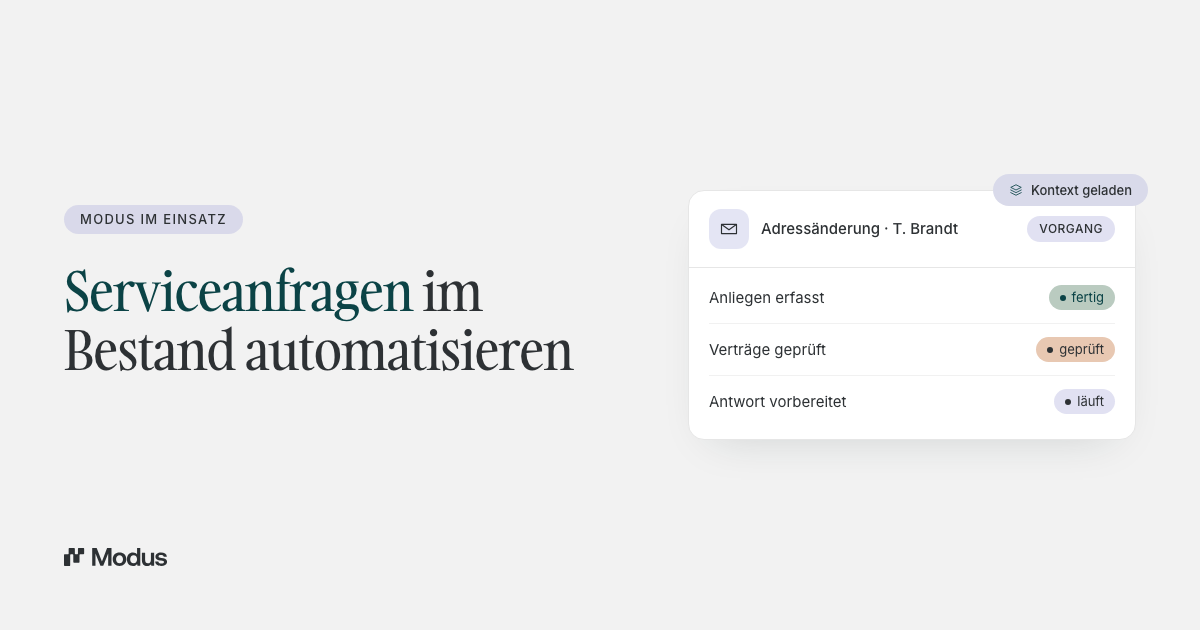
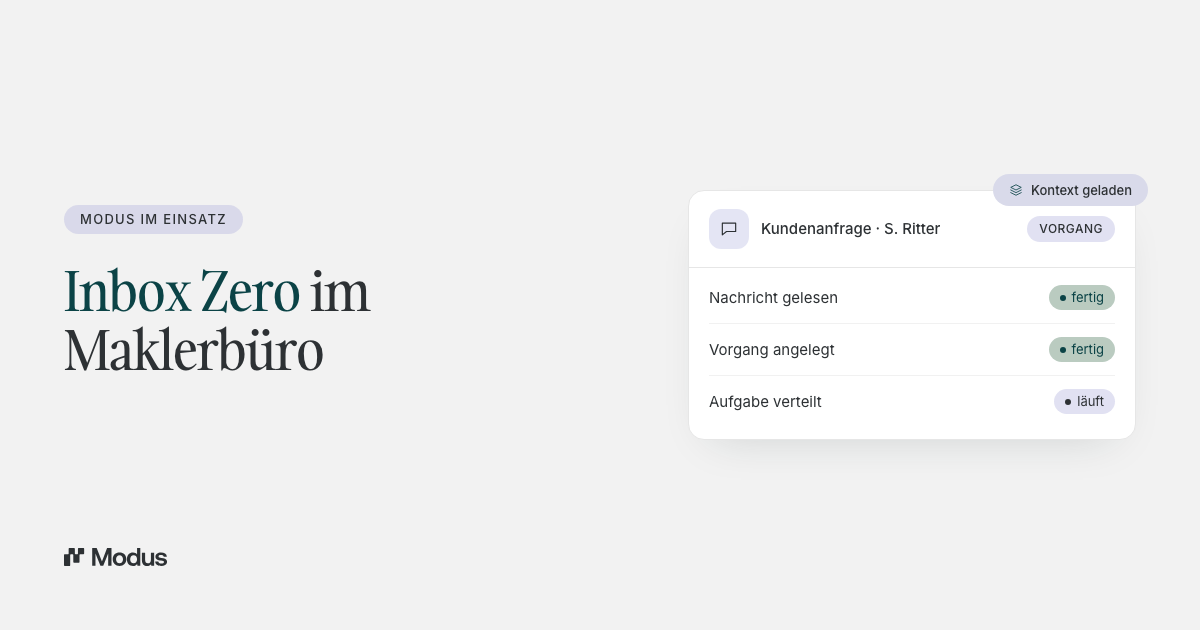
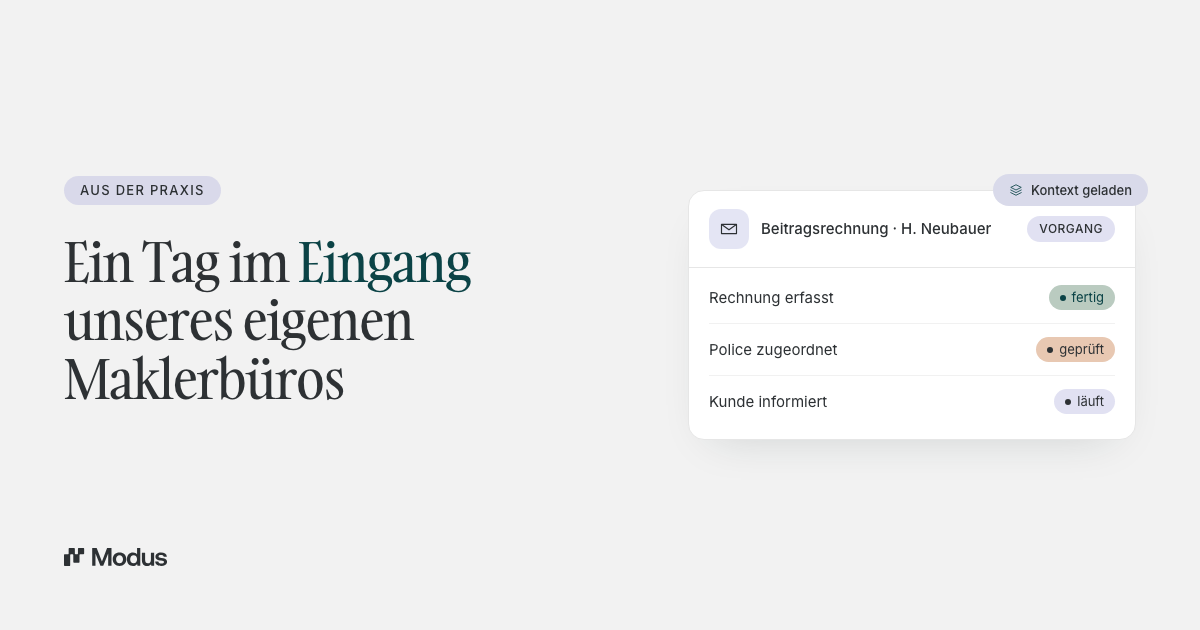
Modus consolidates incoming communication into a structured operational layer on top of the existing management system. Around 80 incoming items become structured cases. Each case has an owner, a priority and traceability. The BiPRO document that used to sit as a PDF in the inbox becomes a policy case with customer, insurer and action. The claim report that was previously an email thread becomes a claim case with all attachments, the next follow-up reminder and the finished insurer letter as a draft.
The same glass breakage case looks different in this model. Instead of an inbox with 80 unsorted messages, in the morning the employee opens a case list with clearly assigned cases. The glass breakage is already identified as a claim case, insurer and affected contract are linked, the missing mandatory details are flagged, and the draft of the insurer email is ready. The employee reviews, adds what is needed and approves. Instead of 10 to 25 minutes, that is 1 to 2 minutes of structured execution.
Scaled to the morning, that means: the three hours per employee per day that today flow into translation move out of administration and into advice. The inbox does not disappear in the process, it is simply no longer the bottleneck.
The leverage therefore lies in the architecture of how work even enters the operation in the first place. It is about more than a faster email reply.
What Has Changed for Us Since Modus Has Been Running in Our Own Operation.
Modus runs today in our own brokerage. We therefore describe the before and after not from a demo, but from daily use.
The most visible effect is where the most time used to disappear. Quote preparation and the preparation of appointments, the two biggest items, no longer start from zero. The context is available in structured form, a draft is prepared, the employee reviews and approves. Ten to 25 minutes of manual groundwork per case become 1 to 2 minutes of structured execution. The time freed up flows back to where it generates revenue.
An Operational Layer on Top of the Management System.
At this point a clarification is important, because we hear it in every conversation.
Modus is not another management system and does not replace the system in which contracts, customers and books of business are maintained. It is not a CRM and does not replace the sales logic, not an AI assistant that answers questions in a chat, and not an add-on that is set up inside an existing management-system module.
Modus is an operational layer on top of Outlook, BiPRO delivery and the existing management system, an architecture that takes in incoming communication, structures it and delivers it to the team as executable cases. If your setup changes, if you switch management systems, if you connect a different pool, your operational layer does not change with it. That is the decisive point.
Modus is pool-independent. That is more than a technical property, it is a commercial and structural decision. Anyone who builds an operational AI layer into a pool contract ties operational efficiency to the pool dependency. We deliberately separate the two.
Concretely, that means: if you switch your pool or your management system today, your operational layer moves with you. With a pool-bound solution, you would start over from zero at this point. That is precisely the essential difference from the pool-bound approaches that are most visible in the market.
Some pool-bound solutions sit deep inside the management system with several specialized language models, work reactively via voice and chat commands as of today, and remain tied to the respective pool. Other solutions work with several proactive AI agents but remain tied to the respective pool structure. Both approaches have their justification, but both remain tied to the respective commercial platform.
Modus remains an operational layer on top of the management system and does not work inside it. That is exactly why it keeps working even when everything around it changes.
Why We Build This Ourselves.
We build Modus because we ourselves sit in front of this inbox every morning.
We are not a large operation: around 2,000 customers, three to four people in the brokerage. That is exactly why we see the same bottlenecks you see.
At SureIn we have never had a demand problem. SMEs need property insurance, the business is there. What has held us back, and what still catches up with us in every growth spurt, is the question of how much administration we have to build up with every new book of business, how many additional person-hours flow into translating incoming items into cases, and how many follow-up reminders per person can still be maintained cleanly before quality suffers.
Insurance intermediaries do not have a demand problem; their bottleneck is an operational problem. We know this because we run a brokerage ourselves.
That changes the way we build Modus. What we build is the operational layer that we ourselves need every day in our brokerage, not a generic B2B product for many industries. The case types that appear in this article are the case types we test Modus against every day. The time ranges we cite are the ranges in which we measure.
Building operational leverage instead of building up headcount is, for us, more than a positioning. It is the question we have to answer for ourselves, every Thursday, 8:30 a.m.
FAQ
How many incoming items typically pile up overnight?
In our brokerage, incoming items between Wednesday 6:00 p.m. and Thursday 8:30 a.m. add up to around 80. That is a typical order of magnitude for an SME property insurance office with around 2,000 customers and three to four people in the operational team. In weeks with a higher claims frequency or many BiPRO deliveries, the figure is higher.
Which cases cost the most time?
Measured over the month, it is quote preparation and the preparation of appointments and consultations. After that come claim reports, service and policy documents, premium queries, research, applications and follow-up queries. The most expensive workflows are not those that seem the loudest in the inbox.
How long does a standard case take manually today?
Between 10 and 25 minutes, depending on complexity. A simple glass breakage claim with clear details is closer to 10 to 15 minutes. A premium query with research in the management system, or a switch application with a comparison, is closer to 20 to 30 minutes. Eight to ten such cases per employee per morning are typical.
How much of that does Modus save per employee per day?
We measure the effect in our own operation against the range between today and structured execution. The same case executed in structured form is 1 to 2 minutes instead of 10 to 25. Extrapolated to a working day, that is up to three hours per employee per day moving out of administration and into advice. In our brokerage with three to four people, that corresponds to more than a full full-time equivalent that today disappears into translation.
Does Modus replace our management system?
No. Modus is a layer on top of the existing management system that neither replaces it nor merges into it. The management system remains the system in which contracts, customers and books of business are maintained. Modus takes over the operational level, that is, how incoming communication is translated into structured cases and delivered.
Is Modus tied to a pool?
No. Modus is pool-independent. That is a deliberate architectural and commercial decision. If your pool, your management system or your insurer connection changes, your operational layer does not change with it. That is exactly why Modus also works in multi-pool setups or when the setup changes.
How does Modus differ from pool-bound AI solutions?
Some pool-bound solutions sit deep inside the management system with several specialized language models, work reactively today via voice and chat commands, and remain tied to the respective pool. Other solutions work with several proactive AI agents but remain tied to the respective pool structure. Modus sits as a pool-independent layer on top of the management system and does not work inside it. That is a question of architecture and comes after the individual feature.
Is Modus available for our office yet?
Yes. Modus is live and in daily use, including in our own brokerage and with first customers. Anyone who wants to see what the operational layer looks like in their own setup can book a demo.
Closing
Yesterday: work arises unstructured in the inbox and is built up manually. Three hours per employee per day go into translation before the first real case is even executed.
With Modus: work arises structured and is prepared by the system. Eighty incoming items become cases with an owner, a priority and traceability. Ten to 25 minutes per case become 1 to 2.
That is how the inbox turns into executable work instead of a growing backlog.
Scale revenue. Not headcount.