How AI is changing the insurance broker's business model
AI is fundamentally reshaping the business model of insurance brokers. Not through individual tools, but through a structural change in how operational work gets done.
By Daniel D.
Modus
Last updated: May 18, 2026
News & InsightsMonday morning, 7:48. You open Outlook and see 47 new emails. Three claims notifications, one policy cancellation, eight follow-up questions on ongoing cases, two BiPRO documents from insurers, and the rest: quotes, newsletters, internal coordination. Before you call your first client, two and a half hours have gone by. On sorting, assigning and documenting alone.
That's not a bad morning. That's the normal state of affairs in a growing brokerage.
And this is exactly where the real change driven by artificial intelligence begins. Not with individual tools. Not with a new plugin for your broker management system. But with the question of how work comes into being in your business in the first place.
The traditional business model is reaching its limits
The classic business model of the insurance broker follows a linear logic: more clients mean more policies, more policies mean more administration, more administration means more staff. Those who grow, hire. Those who don't hire, don't grow.
This model worked for decades. It no longer works today.
Three structural factors have changed the underlying conditions:
1. A shortage of skilled sales staff. According to the current DIHK skilled-labour report, more than 40% of financial services providers cannot fill open positions. The insurance industry is ageing faster than it can replace its people. By 2030, an estimated 30% of active brokers will retire.
2. Rising client expectations. Clients today expect response times under 24 hours, digital self-service options and transparent communication. Anyone who needs three days to answer a simple policy query loses portfolios to digital providers.
3. Margin pressure from administrative overhead. Studies show that 60 to 80 percent of working time in an average brokerage goes to administration. Not to advice. Not to sales. To working through incoming cases.
The result: growth becomes a paradox. More clients create more operational load. That load ties up capacity. And the tied-up capacity prevents further growth.
What AI actually changes in the brokerage (and what it doesn't)
When people talk about AI for insurance brokers, the conversation is often about individual use cases. A chatbot here, automatic text recognition there. That falls short.
The real change doesn't lie in new features. It lies in how operational work comes into being and gets processed. Five areas where this is already visible:
1. Structuring incoming communication
Every email, every WhatsApp message, every BiPRO document contains a task. Today a person recognises and classifies that task manually. That costs time and is error-prone, especially under time pressure.
AI systems can analyse incoming communication, identify the case type (claim, enquiry, cancellation, policy change) and automatically assign it to the right team member. Priorities are set, and context information (client history, ongoing cases, policy data) is linked automatically. The person reviews and signs off instead of sorting it all themselves.
In a brokerage with 10 employees and 80 to 120 incoming messages per day, that means two to three hours of sorting work disappear. Every day.
2. Needs analysis and risk assessment
ChatGPT for insurance brokers has shown that AI can support the analysis of client profiles and risk classes. Specialised systems go further: they reconcile portfolio data with market comparisons, identify coverage gaps automatically and prepare advisory opportunities before the broker even gets involved.
An example: a commercial client has business liability cover but no cyber insurance. The AI recognises the pattern, compares it against industry averages and creates a structured advisory proposal. The broker doesn't have to search. They get the case ready-prepared.
3. Claims notification and documentation
A claim typically runs through 8 to 12 processing steps before it reaches the insurer. AI can structure the initial report, assign the relevant policy data, identify missing information and prepare the communication with the insurer. That reduces a 25-minute task to a matter of minutes.
4. Client communication
Standard enquiries (policy queries, address changes, premium invoices) make up a substantial part of day-to-day work. AI generates context-based replies that the broker reviews, adjusts and sends. Instead of composing every reply from scratch, they review and sign off.
5. Portfolio development and recommendations
AI recognises patterns in portfolio data that people overlook. Expiring policies, underinsured commercial clients, life changes (a move, a company founding, staff growth). These signals are automatically turned into follow-ups or advisory opportunities.
This is the area where AI generates revenue directly. Not through efficiency, but through the systematic identification of untapped potential in the existing client base. A broker with 500 clients cannot possibly review every single policy for gaps on a regular basis. An AI can do that daily.
What AI cannot do
Three areas remain reserved for people:
- Building trust. No algorithm replaces the personal conversation in sensitive life situations.
- Complex risk advice. Specialised commercial policies, liability questions and individual coverage concepts require experience and judgment.
- Responsibility. The broker is liable. The final decision has to rest with a person. That makes sense not only from a regulatory standpoint but also from a business one.
AI changes which work you do. Not whether you're needed.
The shift in role: from doer to decision-maker
The structural change doesn't just affect individual processes. It affects the role of the broker itself.
Today, most owners spend their day carrying out work. Answering emails, documenting cases, transferring information. The digital insurance broker of the future works differently: they review and sign off. The operational execution rests with the system.
That's not a gradual difference. It's a different mode of working.
This shift in role has consequences for the skills profile. The broker of the future needs less case-handling expertise and more strategic thinking: which clients have potential? Which risks are being underestimated? Where is a personal touch worth it?
The broker becomes a risk strategist. A portfolio manager. The administration is handled by the system.
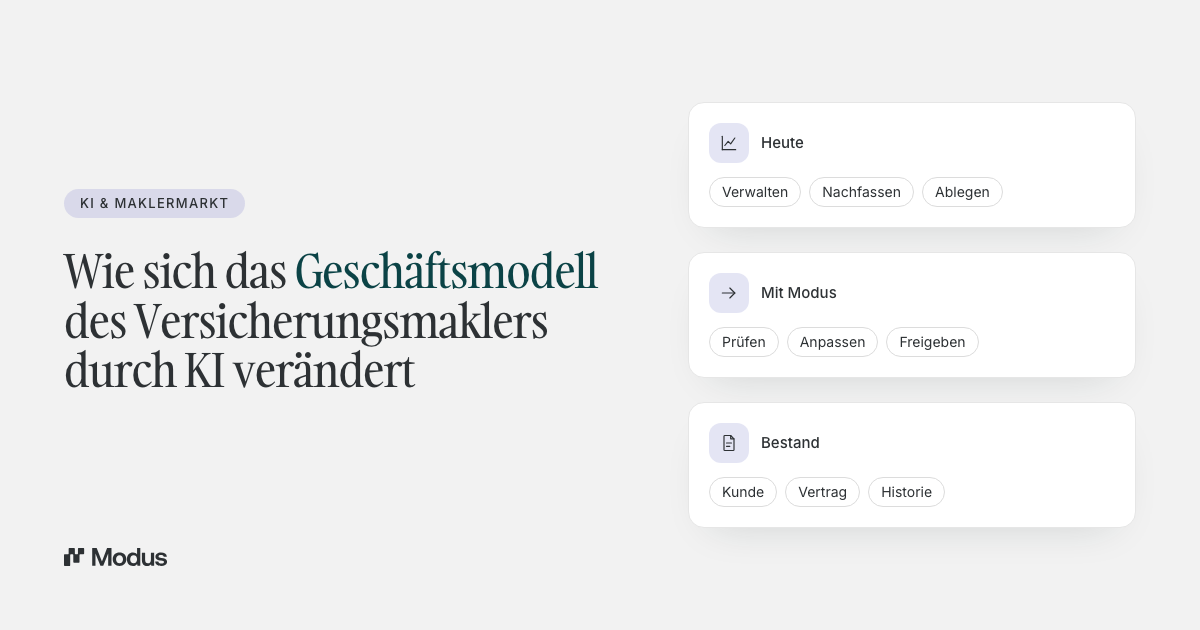
| Today | Tomorrow |
|---|---|
| Work is built up manually | Work arises in structured form within the system |
| The broker carries out cases | The broker reviews and decides |
| Response time depends on capacity | Response time is system-supported |
| Quality fluctuates with workload | Quality is standardized |
| Growth requires more staff | Growth requires better processes |
Scaling without proportional headcount growth
This is where the economic core of the change lies. The traditional model knows only one lever for growth: more staff. The AI-supported model knows a second: operational leverage.
Revenue per employee becomes the decisive metric. Not team size. Not the number of policies alone. But how much value each employee can generate.
An example from practice: a brokerage in Nuremberg with 8 employees automated its operational documentation and case creation with AI support in 2025. The result after 6 months: the average processing time per case fell from 6 hours to 45 minutes. Portfolio revenue rose by 18 percent. Without a single new hire.
That's not an isolated case. According to Versicherungsmagazin, brokers who deploy AI systems in production report time savings of up to 50 percent on administrative tasks.
The math is simple: if every employee can handle twice as many cases, you need half as many new hires for the same growth. Or you grow twice as fast with the same team size.
Scale revenue. Not headcount.
The technology race: what the market is putting forward
The insurance industry is currently living through a technology race over the operational infrastructure of the brokerage. The approaches differ fundamentally.
Part of the market positions AI as an assistant or copilot. The broker asks questions, the AI answers. Others focus on individual use cases such as document recognition, email classification or knowledge bases. AI gets integrated as a feature into existing broker management systems.
Alongside these, a fundamentally different approach is emerging, the one SureIn/Modus is building: AI not as an assistant or a feature, but as operational infrastructure. The goal is not one more tool in the stack, but a structural layer that automatically turns incoming communication into executable workflows.
The distinction matters: an AI assistant answers questions. An AI infrastructure changes how work comes into being at all.
For you as a broker, that means: the technology decision of the next 12 to 18 months will define your operational capability for years. It's no longer a question of whether you use insurance broker software with AI features. It's about which architecture your business ends up with.
Three steps to an AI-supported business model
The transformation of the business model doesn't begin with technology. It begins with clarity about your own processes.
Step 1: Identify your processes
Which cases cause the greatest operational effort? In most brokerages they are:
- Incoming service enquiries (policy queries, address changes)
- Quote creation and comparison calculations
- Claims processing and communication with insurers
- Policy renewals and follow-ups
Start with the case that occurs most often and ties up the largest share of time. Not with the most complex one.
Step 2: Automate it fully
The mistake many offices make: they automate partial steps. A document is recognised automatically, but the assignment stays manual. An email is summarised, but the task still has to be created by hand.
The leverage lies in end-to-end automation. From the incoming communication through case creation to the prepared reply. The person reviews at the end. Not in between at every single step.
Step 3: Make it the standard
Automated workflows only take effect once they function not as the exception but as the normal state of affairs. That means: not a pilot project alongside the day-to-day business, but a new operational foundation.
The most successful implementations we observe in the industry follow this pattern: start small, validate quickly, then roll out consistently. Not everything at once. But don't get stuck at the pilot either.
A realistic timeframe: the first automated workflow can be running in production within two to four weeks. After three months, the two or three most common case types should be covered. After six months, the new way of working is the normal state of affairs.
The decisive point: this is not an IT project. It's an operational decision. The question is not "Which tool do we buy?" but "How should work come into being in our office from now on?"
Frequently asked questions
Will AI replace the insurance broker?
No. AI replaces operational work, not the broker themselves. The role changes: away from execution, towards review, advice and decision-making. Complex advice, building trust and strategic client care remain human domains. At the same time: brokers who ignore AI will find it harder to keep pace with the speed of digital competitors.
Which AI tools are there for insurance brokers?
The market is increasingly differentiating. There are general tools like ChatGPT or Microsoft Copilot, industry-specific assistants for individual use cases (email classification, document recognition) and integrated platforms that provide AI as operational infrastructure, such as Modus. The choice depends on whether you want to speed up individual tasks or change your operational model structurally.
What does the AI Act mean for insurance brokers?
From August 2026, tighter requirements apply to AI systems in the insurance sector. Brokers must document which AI systems they use, inform clients about AI involvement and meet special due-diligence obligations for high-risk applications. The regulation also affects brokers who don't use AI themselves but work with insurers who do. A detailed analysis follows in a separate article.
How much time does AI really save in the brokerage?
Reports from practice show time savings of 30 to 50 percent on administrative tasks. For highly standardised cases (address changes, policy queries) the savings are even higher: from 10 to 25 minutes down to 1 to 2 minutes per case. What matters is whether only partial steps or complete workflows are automated.
How does AI change the role of the insurance broker?
The core shift: from doer to reviewer and decision-maker. Brokers will spend less time on documentation, sorting and standard communication. Instead: strategic advice, portfolio development, new-client acquisition. The ability to evaluate AI results and shape client relationships becomes more valuable than the ability to work through cases quickly.
Do insurance brokers have to use AI to stay competitive?
In the short term: no. In the long term: yes. According to AssCompact TRENDS, 70 percent of brokers already rate AI as important for their future. The competitive pressure comes not from the technology itself, but from competitors who can respond faster, work more cheaply and serve larger portfolios. Anyone who wants to still be relevant in three years should start now.
Don't miss any developments in AI for insurance brokers. Sign up for updates now.