The most common mistakes in AI onboarding at a brokerage
Introducing AI at a brokerage rarely fails because of the technology. The seven most common onboarding mistakes, drawn from our own brokerage, and the order that actually works.
By Daniel D.
Modus
Last updated: Jul 22, 2026
News & InsightsMonday morning, just after eight. A brokerage with eleven employees switched on an AI tool over the weekend. The licence was bought quickly, the vendor had demonstrated convincingly how an email gets answered in seconds. Three weeks later, exactly one person is still using it: the managing director himself. The other ten have gone back to the old way of working. The inbox is just as full as before, the follow-ups are piling up, and no one can say whether the tool has achieved anything.
We experience this daily, first-hand, in our own brokerage with around 2,000 clients rather than in a test environment. Modus grew out of exactly this operational reality, and that's precisely why we know: introducing AI at a brokerage almost never fails because of the technology. The causes lie in the order of steps, in a lack of structure, and in an onboarding that skips over the people and the data.
The numbers bear this out. According to the 17th AfW broker survey on AI use in financial and insurance advice (1,173 participants, November 2024), 35 percent of intermediaries now use AI actively, a doubling from 16 percent the previous year. But only 10.5 percent use it daily. Between "we have a tool" and "we work with it" there's a gap. That gap has a clear cause: it's the sum of avoidable mistakes.
We've collected the seven most common ones: from our own firm, from conversations with design partners, and from the patterns that keep repeating across the industry. At the end comes the order that actually works.
Mistake 1: tool first, goal later
The most common mistake happens before the first login. An office buys an AI tool because the demo was impressive or because a competitor is advertising with it. Only afterwards does the question arise of what it's actually meant to be used for. That's the wrong order.
AI is not an end in itself. It unfolds its value as a lever, and a lever needs a point of application. Without a clearly defined use case, the tool spreads across ten half-hearted attempts, none of which makes a measurable difference. That's exactly why, according to an MIT study on the state of AI in business in 2025, only around 5 percent of generative AI initiatives make the leap from pilot to productive operation. Most get stuck in the gimmick phase.
Start with the question "Which process costs us the most operational time?" and only then with "Which AI tool do I buy?". In the typical brokerage, that's recurring service requests: address changes, policy enquiries, claims notifications, simple quote requests. An address change classically takes between 5 and 25 minutes, because context has to be gathered, data transferred and confirmations sent. That's a concrete, measurable point of application.
So the order is: define the goal, then choose the fitting use case, then the tool. Anyone facing the choice of tool should know the criteria we described in "How to choose the right software for your brokerage".
Mistake 2: a pilot without measurement
Many offices start a pilot and afterwards can't say whether it was a success. It somehow felt faster, or maybe it didn't. This uncertainty is fatal for any AI introduction, because without proof no one on the team is convinced and the managing director can't make a decision about rolling it out.
A pilot without a before-and-after measurement ends up being a gut feeling. Before you set AI loose on a process, you need a baseline: how long does this process take today? How many steps does it involve? How often does it happen per week? Only with this baseline does the effect become visible.
Define two or three hard criteria before you start. This table shows what a robust measurement grid looks like:
Only these numbers turn an impression into evidence. They're also the basis for later scaling from pilot to regular operation, without deciding blind. The high abandonment rate speaks for itself: according to Gartner, the share of abandoned AI projects has risen from 17 to 42 percent, as reported on Gartner's forecasts for AI projects. A good part of these abandonments is simply a consequence of missing measurement. What you don't measure, you can't defend.
| Criterion | Before (baseline) | Target | How measured |
|---|---|---|---|
| Handling time per case | e.g. 18 min | under 5 min | Stopwatch / timestamps in the system |
| Turnaround time to client reply | e.g. 1.5 days | same day | From receipt to send |
| Error / follow-up query rate | e.g. 12% | under 5% | Share of returns |
| Employee acceptance | not measured | active use by the majority | Weekly spot check |
Mistake 3: setting AI loose on dirty data
AI is only as good as the data it works on. That sounds banal but is almost always skipped in onboarding. An office with scattered client data, duplicate records, incomplete policies and information sitting in Outlook, in the broker management program, in WhatsApp and in local folders won't get better results from AI. The AI merely produces errors faster.
Data quality is the prerequisite. It belongs at the start of every AI introduction. When the AI accesses an incomplete client context, it generates a plausible-sounding but wrong answer. In the broker business, where coverage sums, deadlines and liability are at stake, that's not a cosmetic problem.
That's also why at Modus we consistently put structure before automation. Automation without structure is risky, because it scales errors instead of work. Why this principle is non-negotiable is something we described in detail in "Automation without structure is dangerous in insurance". Before AI can turn incoming communication into clean, structured cases, the underlying data has to be reliable and in one place.
In practice that means: consolidate the channels first. A universal inbox in which email, WhatsApp, documents from BiPRO, appointments and phone notes come together creates the dataset on which AI can work meaningfully in the first place. That system integration and inconsistent interfaces are brokers' daily dilemma is also described by AssCompact in its analysis of the interlinking of digital tools in the brokerage. Anyone who skips the data foundation builds on sand.
Data protection belongs in the same preparation. According to the Bitkom survey on AI use and barriers in business, 48 percent of companies name data protection as a central hurdle to using AI. Anyone who pushes dirty data into an AI system without knowing where it's processed has a double problem.
Mistake 4: putting AI into the tool sprawl
The typical brokerage works with a patchwork rather than a single system. Broker management program, Outlook, WhatsApp, a comparison calculator, a pool platform, plus Excel lists and a few industry tools. Into this landscape an AI add-on is then dropped that speeds up a single step. The result is yet another tool that doesn't talk to the others.
AI on a patchwork amplifies the underlying problem instead of solving it. Every break between two systems means manual transfer, loss of context and a new source of error. An AI tool that sits in one of five systems can't see the entire process at all. It patches a symptom and leaves the cause untouched.
Here lies a decisive structural point that most onboardings overlook: pool lock-in. Many AI functions are tied to a particular broker management program or to a pool's infrastructure. They only work within that one world. If the office changes pool, management program or connection, the painstakingly built AI layer is worthless. This pool lock-in is far more than a technical detail; it's a commercial dependency.
Modus is deliberately designed to be pool-independent. The operational layer sits above the individual tools rather than inside one of them. It consolidates the channels and structures incoming communication into work objects with an owner, priority and traceability, regardless of which management program or pool runs in the background. Modus integrates into your broker management program and into Outlook, rather than replacing them.
What the difference between yet another tool and an operational layer means concretely is explained in "What an operating system for insurance brokers is" and in the comparison "Broker management program versus operating system". The core: an AI add-on speeds up a step, while an operational layer creates and structures the entire process.
| Approach | What happens | Consequence for onboarding |
|---|---|---|
| AI add-on in a patchwork | A single step gets faster | Breaks and loss of context remain, another siloed solution |
| AI tied to a pool / BMS | AI works only in one world | Dependency, loss when switching |
| Pool-independent operational layer | Channels consolidated, the whole case structured | Data in one place, automation with structure |
Mistake 5: underestimating change management and leaving usage to chance
The best AI tool is useless if the team doesn't use it. This is exactly where most introductions fail, and it's the most underestimated mistake. Software is bought, switched on and then left to its own devices, on the assumption that good tools will catch on by themselves. They don't.
The effect of structured change management is measurable. According to an analysis of social collaboration in the context of AI acceptance in mid-sized companies, the adoption rate can rise from around 15 percent to as much as 75 percent when the introduction is accompanied rather than merely announced. That's the difference between a dead licence and a tool that's actually worked with.
Behind this stands a principle coined by the Boston Consulting Group, the 10-20-70 rule: in the success of AI projects, only about 10 percent falls to the algorithm, around 20 percent to data and technology, and about 70 percent to people, processes and culture. Anyone who puts 100 percent of their attention on the technology during onboarding and zero on the people is working on a tenth of the problem.
The team's reticence is real and understandable. An analysis of why many intermediaries still hesitate on the topic of AI shows: it's less about a hostility to technology than about fear of losing control and about the question of whether one's own role will be preserved. Taking this worry seriously is part of onboarding and not a sideshow.
A clear framing helps here: AI takes over the manual work behind the advice and does not replace the intermediary. The role shifts from executing to reviewing and approving. Anyone who shows the team that the AI takes over the tedious groundwork and that the professional decision stays with the human removes the biggest resistance from the room. And the framing should be age-neutral: the lever applies to the 25-year-old case handler just as much as to the 58-year-old owner. Onboarding that only brings along the tech-savvy loses half the office.
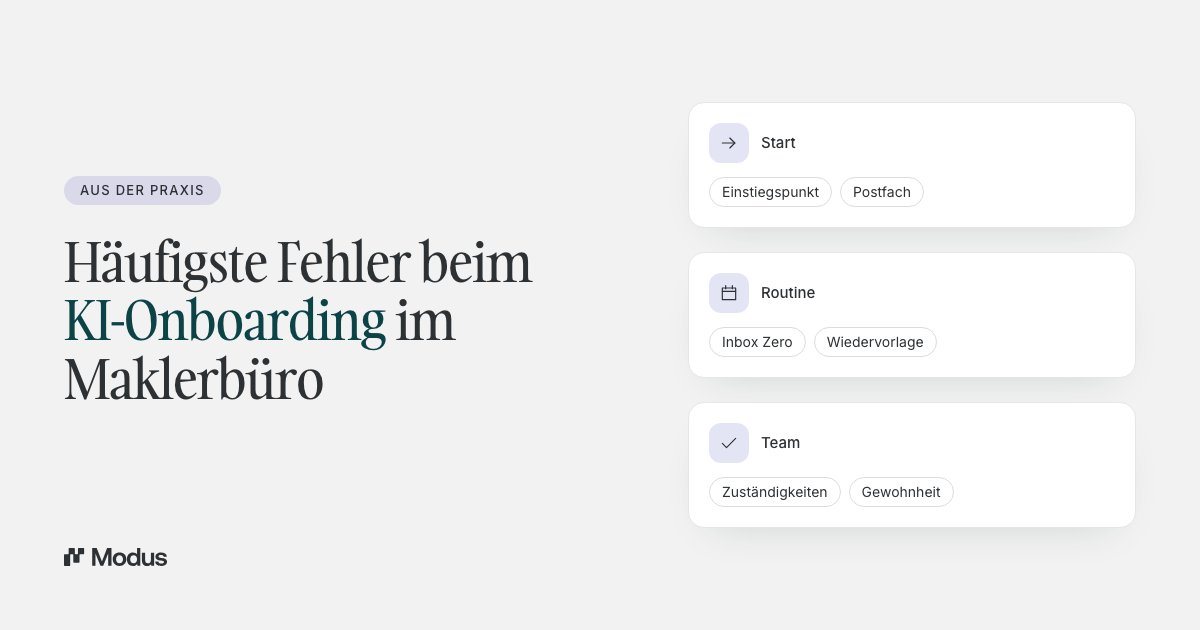
The second part of this mistake only shows up after the kickoff: the tool is introduced but doesn't become routine. An employee occasionally opens the new system alongside Outlook but keeps working in the old workflow. That creates hardly any added value, just another open window. Tools only unfold their benefit through habits. The difference between a team that achieves significantly more with AI and one that barely notices anything rarely lies in the features. It lies in a few consistent behaviours.
What works in our own onboarding is a habit plan rather than a feature training: one habit per week, building up over the first 30 days. Week one: the new system becomes the entry point, the working day starts there and not in the email inbox. Week two: every incoming request, as far as possible, is handled fully within it. Week three: the team joins in, with delegated tasks and comments on the case rather than shout-outs over WhatsApp. Week four: usage is a habit and no longer needs a reminder. The biggest mistake at the start is trying to master all the features at once.
Whether the switch has succeeded is shown by a simple checklist after 30 days: Does every morning start in the system? Are client requests handled fully within it? Is AI used on almost every request? Is it clear at any time which cases are open? Is the team working on the same information basis? Five times yes means: the introduction is done. Every no shows exactly where adjustment is needed.
Mistake 6: too many building sites at once
When the first AI successes become visible, the next mistake follows almost automatically: the attempt to automate everything at once. Claims handling, quote creation, renewals, portfolio maintenance, client communication, everything is supposed to run through AI immediately. The result is overwhelm on all fronts and progress on none.
Prioritisation is the underestimated discipline of AI onboarding. A brokerage has limited attention, limited time for onboarding, and a team that has to handle the day-to-day business in parallel. Anyone who opens five building sites at once keeps none of them clean.
The evidence is clear: a few well-chosen use cases beat many half-baked ones. Start with a single, clearly delimited process that occurs often and is easy to measure. Address changes or policy enquiries are ideal entry cases, because they're high-frequency, standardised and low-risk. Only when this one case runs stably, is measured and is accepted by the team does the next one get added.
Here's what a robust prioritisation looks like:
This order isn't dogma, but the principle is: one case, stabilise, measure, then the next. The GDV dossier on artificial intelligence in insurance shows how broad the field of application is in the industry. That's exactly why focus is the harder and more important decision.
| Step | Use case | Why first |
|---|---|---|
| 1 | Address change / policy information | High frequency, standardised, low risk, quick to measure |
| 2 | Simple service requests | Clear context, high repeat rate |
| 3 | Quote preparation | More context needed, builds on steps 1 and 2 |
| 4 | Claim notification | More complex, higher risk, needs a stable data foundation |
Mistake 7: ignoring compliance
The last mistake is the most dangerous, because it only becomes visible once it's expensive. Many offices introduce AI without clarifying the legal obligations: there's no inventory of the systems in use, no documented data protection and no training whatsoever. That's no longer a trivial offence.
Since 2 February 2025, the AI literacy obligation from Article 4 has applied under the EU AI Act. Anyone using AI in day-to-day business must give their employees an appropriate understanding of the systems and maintain that. This obligation already applies today. Further obligations, in particular the transparency obligations under Article 50, become applicable from 2 August 2026. From then, for example, chatbots on broker websites must be identifiable as AI.
For the overwhelming majority of brokerages: they are deployers, not providers. They use others' AI tools and don't develop them themselves. That means the deployer obligations regarding documentation, training and transparency apply, while the far more extensive provider obligations remain out of scope. The IHK explains the EU AI Act obligations for companies in practical terms, and the primary source is Regulation (EU) 2024/1689 in full text at EUR-Lex.
On top of that comes the GDPR. Anyone using an AI system that processes client data generally needs a data-processing agreement with the provider and must know where the data is processed. And the managing director bears personal responsibility. That's no reason to postpone the introduction, but a compelling reason to factor in compliance from the outset rather than only after the fact.
How extensive these concerns are in business is shown once again by Bitkom: legal uncertainty (53 percent), a lack of know-how (53 percent), personnel (51 percent) and data protection (48 percent) are the biggest hurdles to using AI. The BearingPoint study on the young-broker market also confirms how strongly digital and regulatory requirements shape broker work. The good news: the effort is manageable if you approach it in a structured way. We've summarised the concrete steps in "The EU AI Act for insurance brokers", including the deadlines and the question of what really applies on which date.
The right order: how AI onboarding succeeds
All seven mistakes share a common root: the wrong order. AI is bought first, then somehow built in, and the goal, the data, the people and the law come afterwards, if at all. Turn that around. Anyone who wants to introduce AI at a brokerage and do it right proceeds in this order.
This order is the lesson from a real brokerage that made exactly these mistakes itself and corrected them. The decisive difference lies in the layer beneath the AI tool: whether incoming communication is translated in a structured way into clearly defined cases, or whether AI is set loose on a disordered jumble of five systems.
That's exactly what Modus is built for: as a pool-independent operational layer rather than yet another AI add-on. It consolidates incoming communication from all channels, turns it into cases with an owner, priority and traceability, and thereby creates in the first place the foundation on which AI can work meaningfully and safely. The broker's role shifts from executing to reviewing and approving.
| Step | What happens | Why at this point |
|---|---|---|
| 1. Goal | Define the business goal and the most expensive case | No goal, no use case; no use case, no lever |
| 2. Data | Consolidate channels, establish data quality | AI on dirty data scales errors |
| 3. Pilot | Pick one case, capture baseline values | No before value, no proof |
| 4. Measure | Compare before and after against hard criteria | Proves the effect, convinces the team |
| 5. Scale | Add the next case only once things are stable | Focus beats doing everything at once |
| 6. Compliance | Secure competence, documentation, transparency, GDPR | From the start, not after the fact |
Frequently asked questions
What are the most common mistakes when introducing AI at a brokerage?
The seven most common mistakes are: buying a tool without a clear goal, starting a pilot without measurement, setting AI loose on dirty data, putting AI into a tool patchwork, underestimating change management and daily usage in the team, automating too many processes at once, and ignoring compliance. All share the same root: the wrong order. The right one is goal, then data, then pilot, then measure, then scale, with compliance from the outset.
Does data quality have to be right before introducing AI?
Yes. AI only works as well as the data it accesses. If client information sits scattered across Outlook, the broker management program, WhatsApp and local folders, the AI produces wrong results faster rather than better ones. Data quality is therefore the prerequisite and not a later clean-up job. The first step is to consolidate the channels in a shared inbox before setting AI loose on the dataset.
How do you measure whether an AI pilot was a success?
With a before-and-after comparison using hard criteria. Before you start, record the handling time per case, the throughput time to the client response, the error or query rate, and actual usage in the team. Define a target value for each criterion. Only this comparison turns an impression into robust evidence that convinces the team and supports the decision to roll out.
How do you ensure the team uses AI regularly?
By making usage a habit rather than an option. A 30-day plan with one habit per week has proven effective: first establish the new system as the daily entry point, then handle every incoming request fully within it, then bring the team in with delegated tasks and comments, until usage becomes second nature. A simple checklist after 30 days shows whether the switch has succeeded. Sporadic usage alongside the old workflow, by contrast, creates hardly any added value, just another open window.
What obligations apply to insurance brokers under the EU AI Act?
Most brokerages are deployers, not providers, and are therefore subject to the deployer obligations. Since 2 February 2025, the AI literacy obligation from Article 4 has applied: employees who use AI need an appropriate understanding of the systems, which is documented. From 2 August 2026, the transparency obligations under Article 50 become applicable, for example labelling chatbots as AI. In addition, the GDPR applies and, generally, the obligation to have a data-processing agreement.
Is using AI at a brokerage GDPR-compliant?
AI can be used in a GDPR-compliant way, but not automatically. Anyone using an AI system that processes client data generally needs a data-processing agreement with the provider and clarity about where and how the data is processed. Data protection therefore belongs in the preparation from the outset. According to Bitkom, 48 percent of companies name data protection as a central hurdle to using AI, which shows how important clean clarification in advance is.
How many use cases should you tackle at once?
One. A few well-chosen use cases beat many half-baked ones. Start with a single, high-frequency and easily measurable process such as an address change or policy enquiry. Stabilise this case, measure the effect and bring the team along before you add the next use case. Anyone who opens five building sites at once keeps none of them clean and risks the whole onboarding stalling.
Does AI replace the insurance broker?
No. AI takes over the manual work behind the advice and does not replace the intermediary. The role shifts from executing to reviewing and approving: AI prepares cases, structures incoming communication and suggests replies, while the professional decision stays with the human. It's exactly this framing that removes the biggest resistance from the team during onboarding, because it shows that the AI takes over the tedious groundwork and not the advisory competence.