AI software for insurance brokers: what it does and what matters in 2026
A practical overview of what AI software for insurance brokers delivers in 2026, which approaches exist from general assistants to an operational operating system, and what to watch for on GDPR, the EU AI Act and integration.
By Daniel D.
Modus
Last updated: Aug 4, 2026
News & InsightsIt's 8:15, and the inbox already holds more than 60 messages. BiPRO documents, a claims notification, three policy changes, and in between them follow-up questions from clients and insurers. Before the first advisory appointment begins, the first hour has flowed into sorting, assigning and documenting. The cause is rarely a lack of technology. It's that the work comes into being between the systems and gets built up there by hand.
This is exactly where AI software for insurance brokers comes in. The market has become hard to survey in 2026. It ranges from the general AI assistant for 20 euros a month to the specialised platform that reaches deep into broker operations. This overview shows what such software really delivers, which approaches exist, what it costs, and what you should watch for on GDPR, the EU AI Act and integration.
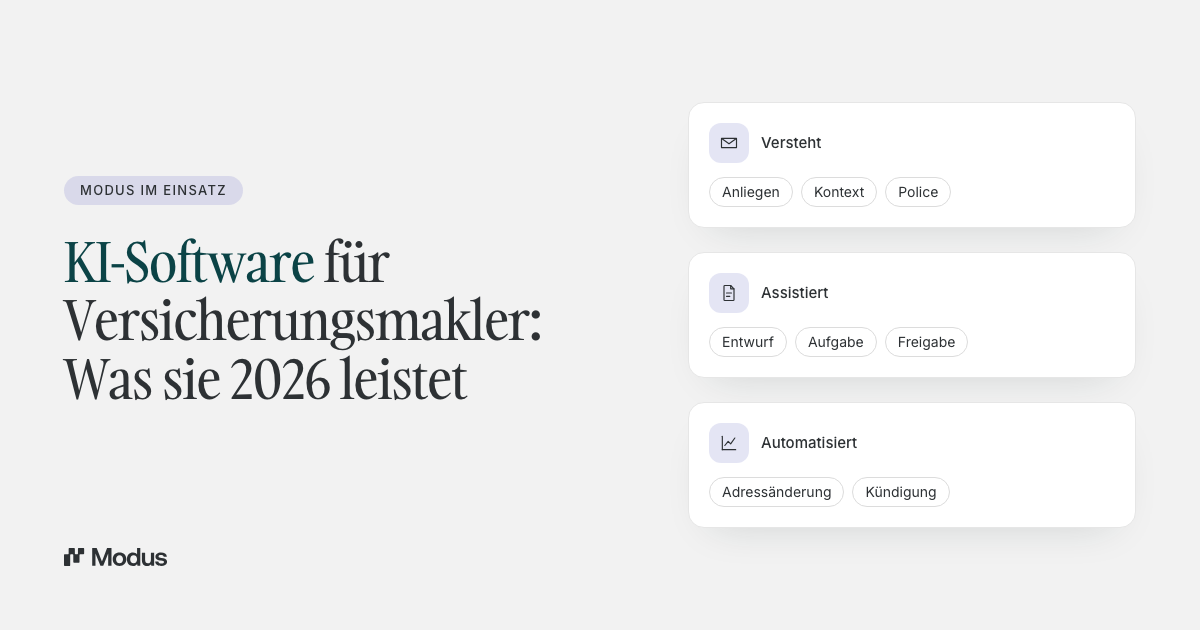
In short: AI software for insurance brokers supports or takes over operational tasks in the brokerage. It reads incoming communication, recognises the case type, assigns information to the right client, prepares quotes and replies, and documents every step. The solutions range from general assistants like ChatGPT to an operational layer that automatically turns incoming enquiries into structured cases.
What is AI software for insurance brokers?
AI software for insurance brokers uses artificial intelligence to automate or prepare recurring tasks in the brokerage. It reads an incoming message, recognises what it's about, loads the matching client context and prepares the next step. The person reviews and signs off.
The term is broadly defined. A general chat assistant belongs to it just as much as a module that sits directly in your broker management system, or a dedicated platform that brings several channels together. What matters is less the label on the box. More important is where in the business the software works and how much work it actually takes off your plate.
This distinction is the thread running through this article. Two tools, both called "AI", can feel completely different in day-to-day use. One drafts a single email faster. The other changes how work comes into being in the office at all.
The need is real. A growing share of independent intermediaries is already investing in AI, and the pressure rises with every new client. For most offices, the concrete implementation therefore moves to the foreground. Which approach fits your own business, and where the greatest leverage lies.
What AI software for insurance brokers can do
The benefit follows the path of an enquiry through the office, from the incoming message to the sent reply. Five areas are particularly relevant here.
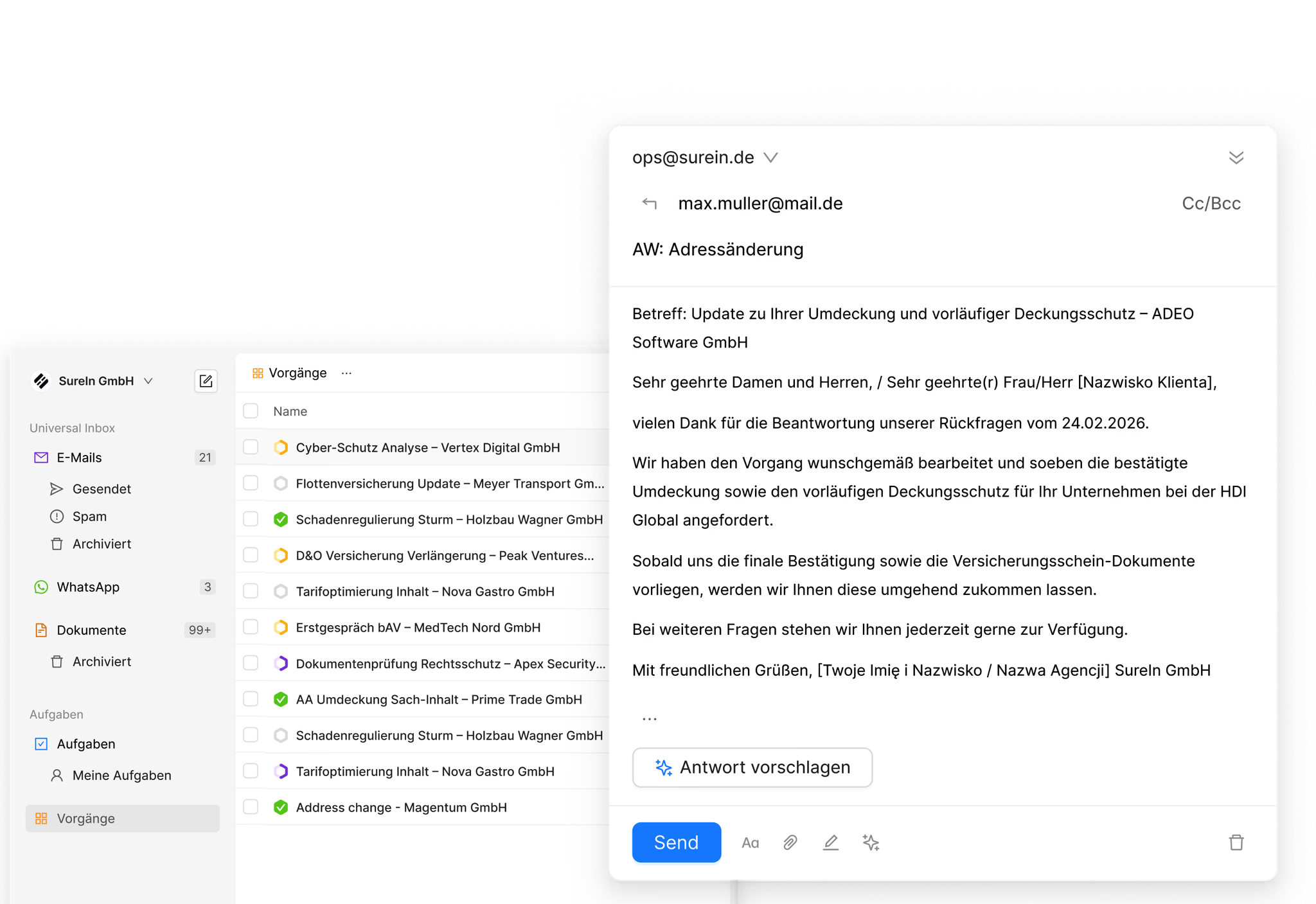
Consolidate incoming communication. Enquiries come in via email, WhatsApp, phone, portals and BiPRO deliveries. Good AI software collects these channels in one inbox, recognises the case type and assigns each message to the right client. Instead of checking five inboxes in parallel, you work from one structured list.
Create cases and tasks automatically. A message becomes a case, with clear ownership and priority. This is the step many general assistants skip. They summarise, but they don't create a task. Software that structures work takes the manual creation and tracking off your hands.
Prepare quotes and replies. On the basis of the enquiry and the client context, a draft is produced that you review, adjust and send. For standard cases in particular, this saves noticeable time, because the rough draft already exists.
Read and assign documents. Policies, endorsements and claims documents are captured and assigned to the matching case. That reduces manual filing and the search for the right document.
Create traceability. Every step is documented on a timeline. That's the foundation for quality, for onboarding new staff and for auditability towards regulators and insurers.
The benefit shows up in the concrete case. An address change for all active policies classically costs between 10 and 25 minutes. Read the email, find the client in the management system, pull up the affected policies, change the address, write a confirmation, document the case. With software that automatically recognises the case type and the client and prepares a draft reply, the effort falls to one or two minutes. Across a whole working day, that adds up to noticeably more time for advice and sales.
| Task | What the AI takes on | Typical effect |
|---|---|---|
| Communication and intake | Consolidate channels, identify the case type, prioritize | Less time spent sorting |
| Cases and tasks | Create a structured case with clear ownership | Nothing falls through the cracks |
| Quotes and replies | Generate a draft from the request and client context | Faster response |
| Documents | Assign policies and BiPRO documents | Less filing and searching |
| Traceability | A timeline per case | Auditable and cleanly documented |
The four approaches compared
All of the following tools carry the "AI" label. In day-to-day use they feel different, because they come in at different points in the business.
1. General AI assistant. Tools like ChatGPT or Microsoft Copilot are flexible and cheap. They help with drafting, summarising and researching. Their limit: they don't know your business. Every case is built up by hand, every context copied in manually.
2. AI as an add-on in an existing tool. Many providers put an AI function on top of an existing program. That's quick to set up and speeds up a single step. But it remains an island workflow that doesn't know the case before and after it.
3. AI directly in the broker management system. Here the AI sits close to the portfolio data. That's an advantage for policies and history. The downside: the solution is often tied to a single provider or pool and narrowed to one channel. A later switch becomes expensive.
4. AI as an operational layer over the management system. This approach places a layer over the existing systems. It gathers several channels and portfolio systems, structures the incoming work and passes it to the team as executable cases. The broker management system stays in place in the background, and the layer remains pool-independent. Modus works on this principle.
A general assistant helps with a single piece of text. An operational layer changes how work comes into being in the business. It takes the incoming message, recognises the case type, loads the client context, creates the case and prepares the reply.
Which architecture fits which setup, we've described in detail in "Broker management system with AI: which architecture really carries your business" and in "What an operating system for insurance brokers actually is". The fundamental difference between a single function and an infrastructure is explored further in "The difference between an AI feature and AI infrastructure".
| Approach | Strength | Limitation | A good fit when |
|---|---|---|---|
| General-purpose AI assistant | Flexible, inexpensive, good for individual texts | Doesn't know your brokerage, every case handled manually | You want to speed up writing and research |
| AI as an add-on | Quick to set up, speeds up a single step | An isolated workflow with no case before or after it | A single step is the clear bottleneck |
| AI in the broker management system (BMS) | Close to the portfolio data | Vendor- or pool-bound, one channel | You are going to stay firmly tied to a BMS anyway |
| Operational layer on top of the BMS | Consolidates channels, structures the work, pool-independent | Needs a clean data foundation | You want to scale without switching your BMS |
What to watch for when choosing
Not every solution that promises AI fits a brokerage. These criteria separate a useful tool from just another tool that only adds complexity.
Integration into your existing systems. Good AI software fits into your broker management system and your email provider, and doesn't replace them. That way you avoid duplicate data entry, system switching and information loss.
Structure before automation. AI only unfolds its benefit on a clean data and process foundation. Automation without structure mostly just speeds up the errors already sitting in the data. Why that's particularly delicate in insurance, you can read in "Why automation without structure is dangerous in insurance".
Data quality and context. An AI is only as good as the context it sees. Check whether the solution recognises related cases and brings the client history together, instead of handling every enquiry in isolation.
GDPR and data processing. Sensitive client data belongs only in a solution with a data-processing agreement, processing in the EU and the clear assurance that your data is not used for training. A free consumer account usually doesn't meet that.
EU AI Act. From 2 August 2026 a transparency obligation applies. Anyone who uses AI in direct client contact must disclose it. What brokers should prepare for is set out in "EU AI Act from August 2026: what insurance brokers need to prepare now".
Traceability. Every automated step should stay documented and auditable. A timeline per case creates the foundation for compliance and for consistent quality, even as the team grows.
Pool independence. The deeper the AI is anchored in a single system, the more expensive a later switch becomes. A layer over the management system keeps this option open for you and doesn't tie your business to one provider.
Which tasks AI software pays off for first
The fastest effect comes where the most manual work sits today: at the point of intake. In most offices, a manageable number of recurring case types carries the largest share of the daily load, such as claims notifications, policy documents, policy changes, premium queries and standard service enquiries.
The second big lever lies in coordination. A brokerage is the hub between client and insurer, and the most time-intensive cases consist of exactly this back-and-forth: querying risk data from the client, obtaining quotes from the insurer, answering follow-ups in both directions, assigning replies, chasing up. As a coordination layer, AI software holds these threads together in one case. Outstanding replies are ready as follow-ups, incoming responses are automatically assigned to the case and summarised, and the next message is ready as a draft. Everything that shuttles between client and insurers stays traceable in one place, instead of spreading across inboxes, notes and weeks.
This is exactly where getting started pays off. Quote creation, where data is gathered manually and calculated individually, is a typical candidate. So is claims processing, which drags on for weeks and generates many follow-up questions. And the many small service enquiries that clearly repeat.
The economic core behind this is revenue per employee. When the same people handle more cases, because the routine is structured and prepared, revenue grows without the team growing at the same pace. How to calculate and manage this metric is shown in "Revenue per employee: the north star by which brokerages should be measured".
Whoever structures and automates these cases first gains time for the work that actually generates revenue.
How to introduce AI in the brokerage
A sensible entry follows three steps, in this order.
First: identify your processes. Start with the case types that create the greatest operational effort. In most offices, those are service enquiries, quote creation and claims processing.
Second: automate fully. Take one case from the enquiry to the result, including context, tasks and communication. A half-automated process saves little, because the break in between eats up the time you gained.
Third: make it the standard. A workflow only takes effect once it's part of the normal way of working and doesn't have to be started deliberately. Step by step, this creates a system that takes over work.
How to choose the right software for your office overall is shown in the guide "How to choose the right software for your brokerage in 2026".
Frequently asked questions
Which AI software is there for insurance brokers?
Roughly speaking, four groups can be distinguished: general AI assistants like ChatGPT or Microsoft Copilot, specialised AI platforms for brokers, AI functions directly in the broker management system, and operational operating systems that work as a layer over the management system. Modus belongs to the last group.
What does AI software cost for brokers?
General assistants start at around 20 euros per user per month in the business version. Specialised platforms and operational systems are usually priced per seat and by scope, and offered on request. More important than the list price is the time saved per employee, which translates directly into more advisory capacity.
Is AI software for insurance brokers GDPR-compliant?
It can be, if there is a data-processing agreement, the data is processed in the EU and the provider does not use your data for training. Free consumer accounts without these assurances are not suitable for real client data.
Does AI software replace the broker management system?
No. Good solutions integrate into the existing management system, which continues to serve as the system of record. An operational layer orchestrates the work on top of it and passes it to the team as structured cases.
Do I have to inform my clients if I use AI?
From 2 August 2026, a transparency obligation under the EU AI Act applies to the use of AI in direct client contact. A note in your communication and in your privacy information is then mandatory.
How quickly will I see results?
For clearly defined case types, the time saving often shows within the first weeks, because the daily routine immediately runs in a more structured way. The full effect comes when several case types are mapped in the system.
Is AI software worth it for small brokerages too?
Yes. Small offices in particular feel the operational bottleneck most strongly, because the owners are themselves in the thick of the day-to-day. A solution that creates structure works especially directly here.
Conclusion
The greatest leverage lies in where in the business the AI works. A single assistant speeds up one step. An operational layer changes the business.
This is exactly where Modus comes in. As an AI-native operating system on top of the broker management system, it turns incoming communication into structured, executable cases, with ownership, priority and traceability from the start. That's how operational time becomes revenue time again.