AI-enabled broker management software: which architecture actually carries your business
AI built into your management system, an add-on beside it, or an operational layer on top: three architectures, but only one carries the whole business. Why the layer above the management system is the durable path and not the exception.
By Daniel D.
Modus
Last updated: Jun 28, 2026
News & Insights"Do I need a new system now? Or is an AI tool I bolt on top enough?" These are questions we hear from brokers more often every day. Every industry site now says that AI is changing the brokerage. But anyone running a broker management system asks: where exactly? How deeply? And with which system?
The answer doesn't hinge on the vendor. It hinges on the architecture. Today there are three structurally different ways to bring AI into a brokerage. And they are not equivalent. Two of them solve a slice of the problem. One carries the business as a whole. Anyone who picks one without having understood the others risks a setup that costs a lot and saves little.
This article sorts the three paths, shows for each what it can do and where it structurally hits its limit, and says clearly which layer carries the business over time.
Why the question isn't "which AI?" but "where does the AI sit?"
The usual discussion revolves around features: voice control, automatic replies, document analysis, policy reconciliation. Those are useful descriptions of individual features. But they don't reveal what actually gets easier in the day-to-day of a 3- to 20-person brokerage.
The sharper question is: at which point in the working day does the AI take hold? Directly inside the broker management system I already use? Beside it, as a specialised tool? Or above it, as a layer that connects my systems and my channels?
Three architectures, three promises, three very different consequences for data ownership, lock-in, scaling and cost. That's exactly the distinction we're drawing here. And it isn't academic. It decides whether AI speeds up a single task for you or structures your entire day.
Path 1: AI native inside the broker management system
Over the past twelve months, the established management-system vendors have released their own AI extensions, tightly integrated into their existing software. These AI extensions from the major management-system vendors run inside their respective existing systems.
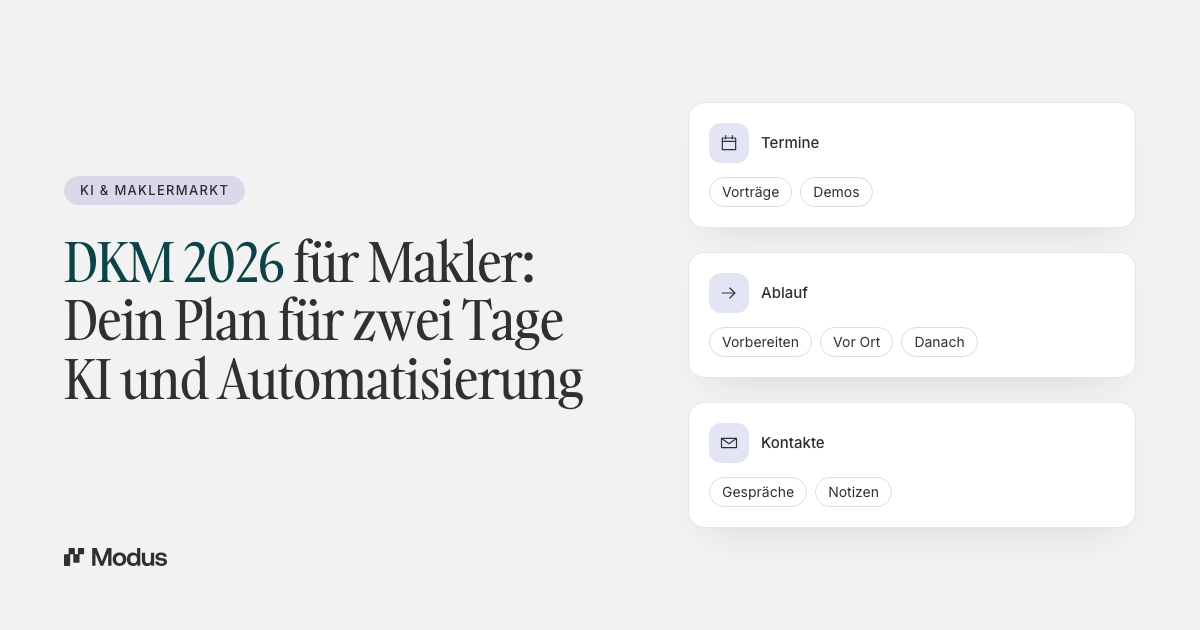
Typical features include natural-language portfolio queries ("Show me all clients with disability cover but no dynamic adjustment" or "Which policies expire in the next twelve months?"), processing incoming BiPRO documents, detecting address changes and claims notifications, and triggering the corresponding follow-up processes. Some providers rely on several specialised models here, others on an agent-based setup with separate responsibilities for clients, policies, cases, claims and portfolio. In every case, the prerequisite is that the respective broker management system is the leading system. With some pool-tied solutions, the AI extension is included for connected agents at no extra cost.
Where this path is strong: the AI sits directly on top of the portfolio data. It knows clients, policies and history and can access them without a detour. For a brokerage that only uses a single management system anyway, this is the fastest way to introduce AI. There's no additional login, no second interface, no separate data upkeep.
Where this path hits its limit: this isn't a weakness of the individual products but a natural consequence of the architecture. Anyone who builds AI firmly into an existing system automatically inherits that system's limits.
First, the AI is tied to precisely this one system. The portfolio-management landscape includes not only the classic broker management system but also CRM systems as a category of their own, in which client and policy data is held. A built-in AI always lives in exactly one of these worlds. Anyone who switches pools, maintains several systems in parallel, or wants to stay free of vendor lock-in can't take it with them.
Second, it naturally only covers the channels the existing system itself knows. WhatsApp, phone, external email inboxes and appointments lie outside this architecture, not because the vendor forgets them, but because they aren't part of its system.
Third, a built-in AI rarely orchestrates the full case. It answers questions and executes commands. It usually doesn't take on the end-to-end flow from an incoming message to a finished, approved reply. That's not an oversight. It's the consequence of being conceived as a feature within the system rather than as a layer above it.
Path 2: AI as an add-on beside the broker management system
The second variant is specialised point tools that run independently of the management system and cover specific workflows.
General AI assistants are already in use in many brokerages today: for drafting text, describing claims, insurance FAQs, client emails. They're cheap, quickly available and cover a broad spectrum. But they know nothing about your own portfolio. Every piece of context has to be entered by hand, and the output has to be carried back into the management system.
Industry-specific add-ons tackle individual bottlenecks more concretely. They put an AI layer on the Outlook inbox, for example, serve voice channels or handle WhatsApp communication. They understand insurance language better than a general model and can automate certain cases.
Where this path is strong: for a clearly bounded problem, a specialised tool is often the fastest solution. Anyone who needs a sorting aid for the Outlook inbox gets there faster with a focused add-on than with a large platform investment.
Where this path hits its limit: every add-on solves one part. But the broker's day consists of many parts that hang together. Anyone running three add-ons side by side has three logins, three interfaces, three data silos. The context is missing in each case, the next step has to be carried by hand, and the economic effect is spread across many small levers. This fragmentation is exactly the problem we described in more detail: why an AI feature is something different from an AI infrastructure.
Path 3: AI as an operating system on top of the broker management system
The third variant is conceptually younger and just emerging in Germany. It treats AI not as a feature inside the management system and not as a tool beside it, but as its own operational layer that sits on top of the existing systems. This layer is precisely the reason this article takes a clear stance: it's the only one of the three architectures that carries the business as a whole, not just a slice.
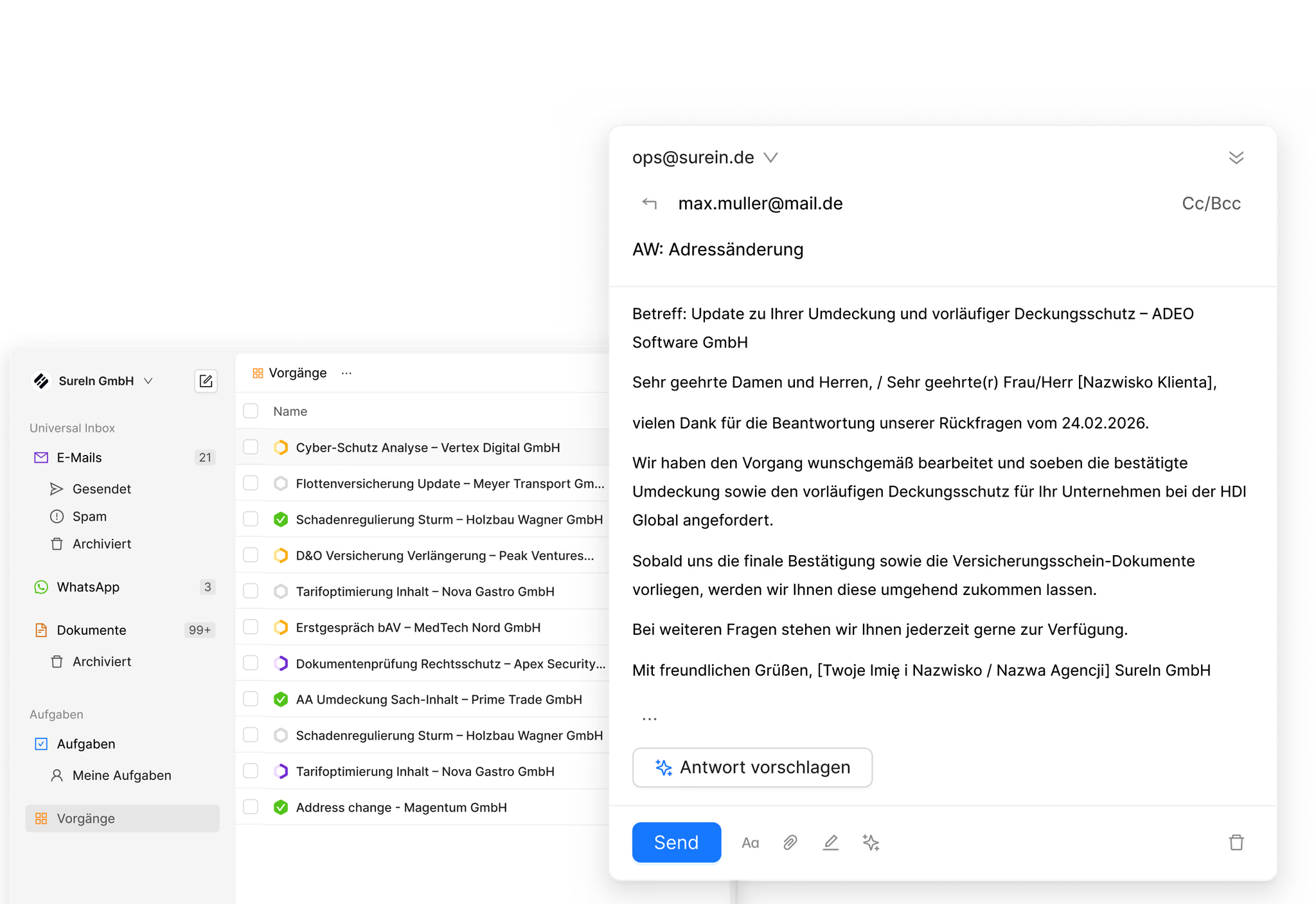
This layer takes in incoming communication from every channel in one inbox: email, WhatsApp, BiPRO documents, phone and appointments. It automatically recognises what a message is about, creates structured cases with ownership and priority, pulls the context from the management system, and prepares the next steps. The broker reviews and signs off. What an operating system for insurance brokers actually is, we've described in detail in a separate article.
One example of this path in Germany is Modus, the operating system behind usemodus.io from the SureIn universe. Such layers are set up vendor-neutral. They connect to different broker management systems via standardised interfaces rather than being one themselves.
Where this path is strong: here it's worth getting concrete, because the advantages of this architecture are structural, not cosmetic.
- All channels in one inbox. Email, WhatsApp, phone, BiPRO documents and appointments come together in one place, not in five separate inboxes.
- The full case from incoming message to sign-off. The layer recognises the case type, creates a structured case with ownership and priority, pulls the context from the management system, and prepares the reply. It doesn't just answer a question, it orchestrates the whole flow.
- Time savings of up to three hours per agent per day. Operational time becomes revenue time, because preparing the cases no longer happens by hand.
- Growth without proportional headcount. More cases in the same time means more premium volume, without having to hire a new person for every increase.
- No pool and no vendor tie-in. The layer is pool-independent. It travels with you if you switch management system, run several systems in parallel or give up a pool.
- A changed role. The broker shifts from executing to reviewing and approving. They still decide, but they no longer build the work by hand.
Where this path hits its limit: this architecture is newer and matures faster, but in individual detail output it isn't yet as deep everywhere as built-in vendor AIs can be after years of management-system development. It needs a clean data base in the management system, otherwise it runs into a void. And it's an investment in its own right, not a free extra of the existing system. That's the price of not being tied to a single system.
Which path for which brokerage
Three architectures, but not three equivalent recommendations. We make no secret of where we point: the operational layer above the management system, the operating system, is the structurally durable path. The other two paths are situationally right, but they're building blocks or transitional solutions, not a foundation for the years ahead.
The reason is simple. Almost every brokerage today has a multi-channel intake. Email, WhatsApp, phone and documents come in parallel, regardless of portfolio size. And almost every brokerage doesn't want to be locked into a single vendor universe over the medium term. It's precisely for these two conditions, multi-channel and freedom from lock-in, that the layer above is built. That's why it isn't the special case for a few offices but the default recommendation for practically any business that has moved beyond simply working through a single inbox.
Brokerage with one management system it wants to keep. The built-in AI extension of your own management system is a good first step, because it's integrated with no extra effort and works on the portfolio data. But it doesn't close the open flank: all the channels outside the management system. As soon as inbox stress and channel fragmentation define the day, and that's almost always the case, an operational layer belongs on top. Path 1 solves portfolio access, Path 3 carries the business.
Brokerage with several broker management systems or a planned switch. Here Path 1 is off the table from the outset, because built-in AI doesn't travel with you. Anyone running several pools, facing a merger, or wanting to switch management system inevitably needs the pool-independent layer. That's Path 3.
Brokerage with a clearly bounded bottleneck. Anyone with a single pain point, such as the voice channel or the WhatsApp flood, can get targeted short-term relief with Path 2. But an add-on is a partial solution with an expiry date. As soon as the second and third bottleneck arrive, the path leads to the layer that brings all channels together anyway.
When weighing this up, it also helps to look at the economic order of magnitude. What makes the right software for your brokerage in 2026 doesn't hinge on the longest feature list, but on the question of whether the system changes your day.
Five typical cases against which any solution can be measured
Regardless of the architectural path, in daily practice it's always the same case types where AI is meant to save time. Anyone who keeps these five concretely in view can measure any offered solution against real work. What matters isn't whether a system speeds up an individual step, but whether it orchestrates the case across all channels. That's precisely the strength of the operational layer.
Quote creation. An enquiry comes in, by email, WhatsApp or phone. The layer recognises the need, pulls the client data from the management system, prepares the matching quote and presents the send-out for sign-off. The case runs across channels, not in the one inbox where the enquiry happened to land.
Address and bank-detail changes. A standard change is captured automatically, recorded and documented in the management system and with the affected insurers. Classically this takes noticeable time depending on the number of policies, because each point is touched individually. Orchestrated through the layer, it becomes a single end-to-end case.
Cancellations. An incoming cancellation is recognised, matched to the right policy, processed on time and paired with the appropriate win-back or confirmation communication. Across all channels, whether it comes in by letter scan, email or message.
Portfolio transfer. When taking over a portfolio or switching systems, cases, documents and open matters are transferred in a structured way, instead of getting lost in an old inbox. A layer that isn't tied to a single management system has a structural advantage here.
Claims notification. A message comes in. The AI recognises the case type, matches it to the policy, checks cover, prepares the insurer notification and updates the client status. A whole chain from message to sign-off, not a single step.
Every one of these cases benefits from AI. But they benefit to different degrees, depending on where the AI sits. Built-in management-system AI is strong on portfolio access. Add-ons are strong in their specific niche. A layer above is strong in exactly what defines the broker's day: orchestration across all channels.
Compliance before features
Since 2025 at the latest, AI in the brokerage has also been a regulatory topic. There are three frameworks you need to know before choosing a solution.
BaFin and the IDD. Insurance brokers have a duty to advise. When AI takes on parts of the advice, the decisions have to remain traceable. Anyone deploying a system that is a black box risks compliance gaps. An architecture that runs every case as a structured case with a timeline has an advantage here, because traceability is built in.
GDPR and LLM setup. Anyone using general AI models without a data-processing agreement and without EU data storage has a GDPR problem. Industry AI in management systems and vendor-neutral platforms are usually set up more cleanly here, because they know the insurance segment. Still, have the provider explicitly demonstrate its GDPR compliance and its ISO 27001 status.
The EU AI Act. The EU AI Regulation came into force in 2024. The obligations for general-purpose AI models have applied since 2 August 2025, with the provisions on high-risk systems following in staggered fashion in 2026 and 2027. What insurance brokers specifically need to prepare, we've summarised in a separate article. Central to it is the transparency obligation: when AI interacts with clients, that has to be recognisable.
These three frameworks are not an obstacle to AI in the brokerage. They're a filter that helps distinguish serious providers from marketing promises. Why automation without structure is dangerous in insurance is described in detail in the related article.
Frequently asked questions
What is a broker management system?
A broker management system is the central software insurance brokers use to manage their portfolio: clients, policies, documents, commissions. It's the leading data layer in which the portfolio data is held, often complemented by a CRM as a system category of its own. Anyone who wants to add AI builds either on top of the management system, beside it, or above it.
What does an AI-enabled broker management system cost?
Classic broker management systems often run at 50 to 100 euros per month per workstation, some are co-financed through pools. AI extensions are partly included, partly priced as an additional module, partly not communicated publicly. More important than the licence cost is the question of how much manual work the system actually replaces.
What AI does my existing management system already come with today?
Most established management-system vendors have released their own AI extensions in recent months. Typical are natural-language portfolio queries, processing incoming BiPRO documents, detecting address changes and claims notifications, and triggering the follow-up processes. These features sit directly in the existing system and work on the data held there. Their limit is that they only cover the channels the management system itself knows and are tied to that one system.
Add-on beside the management system or a layer on top: what's the difference?
An add-on is a specialised point tool that solves a single bottleneck, such as the voice channel or the Outlook inbox. It remains an island with its own login and its own data silo. A layer on top, an operating system for the brokerage, instead brings all channels together in one inbox, creates structured cases and orchestrates the full flow from message to sign-off. The add-on speeds up one step, the layer carries the business.
Do I need a new management system for AI, or is an AI tool on top enough?
Not necessarily. Anyone happy with their existing management system can either use the in-house AI extension (Path 1) or lay a layer on top that leaves the management system untouched (Path 3). Switching the portfolio system is a major project and shouldn't be triggered primarily because of AI, but because of the data layer itself.
Are general AI assistants GDPR-compliant for insurance brokers?
General AI assistants in the standard configuration are GDPR-critical, because data can be processed outside the EU and the data-processing agreement doesn't automatically fit. For use in insurance advice, enterprise contracts with EU data storage or industry-specific LLM setups are required. Clarify this with your data protection officer before using a general model for client data.
How much time does AI really save in the brokerage?
In broker work, large parts of the working time are administrative. A continuous AI layer can take out a considerable share of that, on the order of up to three hours per agent per day. But reliable figures only emerge in your own business, which is why a pilot with a concrete case type is the more honest measure than any marketing number.
Does AI replace the insurance broker?
No. AI shifts the work. The broker still decides, signs off and holds the client conversation. What AI changes is the preparation: incoming communication is structured, context is immediately available, routines run ahead. The human shifts from executing to reviewing and approving and can handle more cases in the same time.
Conclusion
AI in the brokerage in 2026 is no longer a question of hype. It's an architecture decision. And this decision has a clear direction. Built-in management-system AI is fast and deeply integrated, but it stays inside a vendor universe and only knows the channels of its own system. Add-ons solve individual bottlenecks, but they remain islands. What carries the business as a whole is the operational layer above.
This layer brings all channels together in one inbox, orchestrates the full case from incoming message to sign-off, is pool-independent, and shifts the broker's role from executing to reviewing. For practically any business with multi-channel intake and the wish not to be locked into a single system, it isn't the special case but the normal case.
Anyone who understands this distinction makes the software decisions of the coming years on a different footing. Built-in AI and add-ons are useful building blocks. But it's the layer on top that has to carry the load. Scale revenue. Not headcount.
Don't miss any developments in AI for insurance brokers. Sign up for updates now.