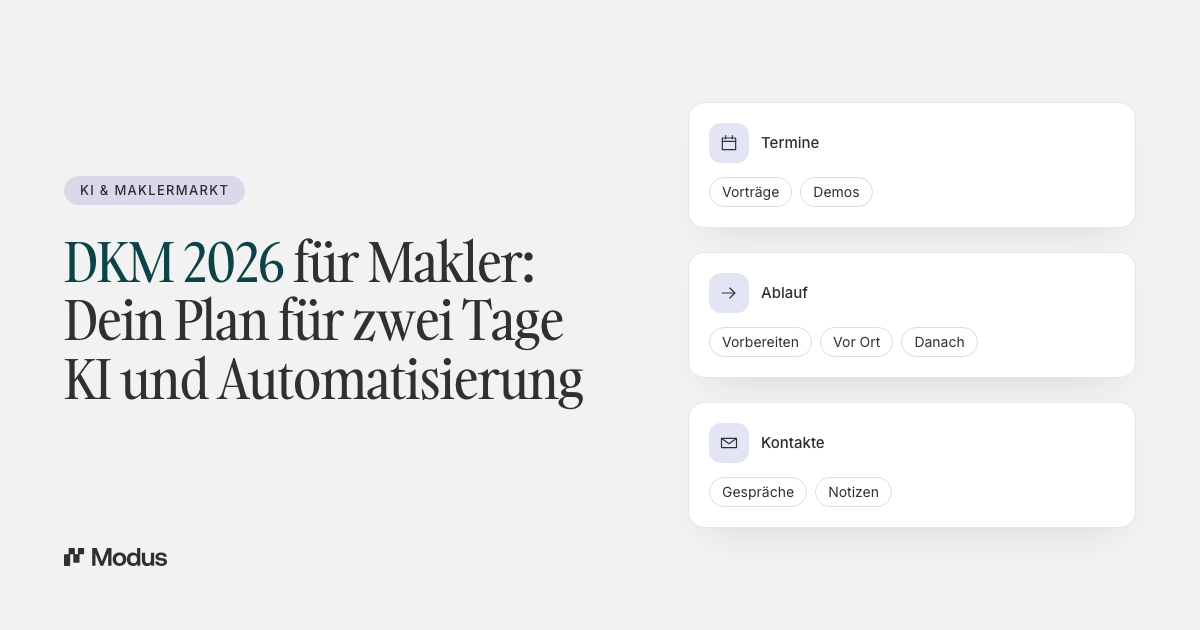
Broker Management Software and AI: Architecture, Lock-In and Cost Compared
Three AI architectures for the brokerage: AI native in the management system, an add-on alongside it, or an operational layer on top. How lock-in, pool dependency and switching costs determine, over time, which architecture holds up.
By Daniel D.
Modus
Last updated: Jul 6, 2026
News & InsightsAnyone running a brokerage in 2026 and weighing up AI usually starts by comparing features. Which AI understands language better, which reads documents more cleanly, which recognizes cases faster. Those comparisons are legitimate, but they come second. Ahead of them sits a question of architecture.
It comes down to where the AI sits in your operation, what it is tied to, and what happens to it when your business changes. Because AI in a brokerage is not an app you uninstall when you no longer like it. It grows into your data, your processes and often your pool as well. The decision you make today binds you for years.
This article therefore looks at AI in the brokerage primarily as a matter of decision economics rather than a pure question of features. It is about lock-in, pool dependency, switching costs and the question of which architecture produces the fewest expensive surprises over time. Three structurally different paths are on the table. They cost not only different amounts of money, but also different amounts of freedom.
Three Architecture Types, Three Lock-In Profiles
Before talking about prices and features, it helps to sort the field into three architecture types. Rather than by brand name, we organize them by where the AI sits and what it depends on.
- AI native in the broker management system. The AI is part of the management system itself. It accesses your book of business directly, knows customers, contracts and documents without any detour, and answers queries or carries out cases from within the system. It is strong in depth because it uses the same data space as the underlying record-keeping, and it is tied to exactly this management system, in practice often to the pool behind it as well.
- A specialized add-on alongside the management system. A standalone tool takes over one clearly defined case type, such as telephony, a voice interface or WhatsApp processing. It sits next to the management system and is connected via an interface or manually. It is strong at that single task but weak on end-to-end flow, because every case ends at the tool's boundary.
- An operational layer on top of the management system. A layer that sits on top of the existing broker management system and orchestrates communication from several channels. The management system remains the system that stores customers and contracts. The layer above it takes over case execution and is not tied to a single record-keeping system or a pool. This is the architecture of Modus, designed to be pool-independent.
Anyone who distinguishes these three types has asked the most important question. It aims less at which AI gives the best answer today than at which architecture will still fit your operation in three years.
AI Native in the Management System: Maximum Depth, Maximum Dependency
The most obvious option is AI built directly into the broker management system. If you work in your management system every day anyway, you get an AI that already knows the context from your record data, with no second login and no separate data upkeep. Voice or chat commands such as a portfolio query are answered straight from the data. In the more proactive build-out, the AI reads incoming documents, recognizes case types and triggers follow-up processes.
That is the strength of this architecture. It is the shortest connection between data and action.
That strength is also the dependency. Native management-system AI belongs to the management system. It works only within exactly that record-keeping system, and in many cases that record-keeping system hangs on a pool. This means the AI question indirectly decides the pool question too, and vice versa. Switch pools and you lose the AI. Maintain several record-keeping systems in parallel and you can only use the AI for part of your operation. The channels the management system does not know about, such as external email inboxes, WhatsApp and telephone, remain out of reach.
For a brokerage firmly anchored in one management system and one pool, and intending to stay there, this dependency is unproblematic and native AI is the most efficient solution. For a firm whose structure is still in motion, it is a bet on the status quo.
Add-On Alongside the Management System: Quick to Start, Hard to Connect End to End
The second path is the specialized add-on, a tool for one task that you place next to the management system: a voice solution for inbound calls, a tool for WhatsApp communication, an AI for a single document type. Such add-ons are quick to introduce and often solve a concrete, well-defined problem immediately.
The economic catch lies in end-to-end flow. Each add-on covers one segment, but no case runs all the way through. The request arrives in the add-on, the context sits in the management system, the answer takes shape in a third tool. Stack three or four add-ons and you buy three or four licenses, maintain three or four data states, and carry the breaks between the systems as manual work. Here the lock-in shifts from the pool to a growing collection of tools that nobody integrates cleanly anymore.
Add-ons make sense when a single, clearly outlined bottleneck needs to be solved urgently. As a permanent base architecture for the whole operation they rarely hold up, because the sum of the parts does not produce end-to-end case logic.
Layer on Top of the Management System: The Record System Stays, Execution Moves
The third path separates two things that are fused together in the first two architectures: record-keeping and case execution.
The broker management system remains the system of record. It stores customers, contracts and documents, just as before. On top of it sits an operational layer as the system of action. It consolidates incoming communication from several channels in one inbox, classifies it, links every case with the customer and contract data from the management system, proposes draft replies and prioritizes the tasks. The broker reviews and approves. Their role shifts from execution to approval.
This is the architecture of Modus. Modus is itself not a broker management system and does not replace one; it sits on top as an operational layer, designed to be pool-independent. As a result, this layer also covers the channels a management system does not know on its own: WhatsApp, external email inboxes, telephone, appointments. The case runs all the way through, from the incoming message to the approved reply, across channels.
The decisive point for decision economics is the decoupling. Because the layer does not sit inside the management system, it is not tied to its pool either. The record-keeping system and the AI layer can change independently of each other. That has consequences as soon as the operation shifts, and that is exactly the expensive part of every one of these decisions.
What an operating system for insurance brokers actually is, and why it complements the broker management system rather than replacing it, we cover in separate articles.
The Comparison Matrix: Architectures Instead of Products
A sober side-by-side of the three architecture types makes the decision logic visible. What gets compared here are the structural properties that play out over years, rather than individual brands.
The matrix shows the pattern. Native management-system AI offers the greatest depth but couples that depth to the highest lock-in. Add-ons are flexible to start with but create new breaks with every additional tool. The layer on top of the management system gives up some record-level depth but gains end-to-end flow across channels and low switching costs. Which column wins depends less on the AI than on how sure you are that your structure will still be the same in three years.
| Axis | AI in the BMS | Add-on alongside the BMS | Layer on top of the BMS |
|---|---|---|---|
| Where the AI sits | Inside the record system | Standalone, off to the side | On top of the record system |
| Lock-in | High, tied to the BMS and usually to a pool | Medium, tied to a collection of tools | Low, decoupled from the BMS |
| Pool ties | As a rule, yes | Pool-neutral | Pool-independent |
| Channel depth | Only the channels of the BMS | One channel per tool | Multiple channels in one inbox |
| Workflow reach | Deep in the BMS, ends at its boundary | Piecemeal, per tool | End to end across channels |
| Switching costs | High, the AI is lost when you switch BMS | Medium, tool by tool | Low, the BMS can be swapped without losing the AI |
| Behavior with multiple BMSs | Covers only one system | Has to be rethought per system | Works across several BMSs in parallel |
| Best suited for | A single BMS with stable pool ties | A single, clearly defined bottleneck | Multiple channels and a shifting structure |
Total Cost of Ownership: The Price Is Not on the Invoice
The monthly license fee is the visible but not the decisive part of the cost. Classic broker management systems often run between 50 and 100 euros per month per workstation, frequently co-financed through pools. Native management-system AI comes bundled without separately itemized extra cost in some pool arrangements, while in others the terms are not communicated publicly. Add-ons are licensed individually. A pool-independent layer is agreed per firm.
Those figures are the first level. The more expensive level is the cost that only arises once something changes.
Cost of a pool switch. If you bet on native management-system AI and then switch pools, you lose the AI along with the management system. What remains is a trained team, established processes, and the need to rebuild both. These costs appear in no offer, yet they land precisely when a lot is already in motion.
Cost of a merger and multi-system setups. When a merger brings two record-keeping systems together, or a growing firm maintains several management systems in parallel, native management-system AI can serve only part of them. The rest stays manual or demands a second or third AI system. A layer on top works across several management systems and largely neutralizes this cost block.
Cost of tool fragmentation. With an add-on strategy, the number of licenses, data states and integration points grows with every new bottleneck. The license is cheap; the integration and the manual bridging of system boundaries are not. These costs are spread across everyday work and are rarely recognized for what they are.
Cost of a poor data foundation. Regardless of architecture, one rule holds: AI on chaotic record data is an expensive amplifier. Anyone starting with AI should audit their book of business first, or they will scale disorder.
The honest calculation adds to the licenses the probability of a pool switch, a merger or a growing multi-system operation, multiplied by the costs that the respective architecture would cause in that case. That is exactly where it is decided which path is the cheaper one over time.
What Independent Tests Say, and Where They Are Blind
The German trade press provides an initial basis for comparing broker management systems, but the established tests date from before the AI wave. What they measure is the integration, enablement and added value of the management systems. The AI capability of the systems is explicitly not a criterion in these surveys.
For the architecture decision, that means: independent tests do not yet assess the AI capability of the management systems. Anyone looking for a current, comparative industry test of the AI extensions will not find one in 2026. Coverage in the trade press is extensive but mostly launch-driven and focused on individual providers, not comparative.
A sober consequence follows. A sound selection today rests less on a ranking than on a structured self-assessment pilot. Which case type is to be served, with what data foundation, over which channels? And above all: how certain is your own pool and management-system structure over the next few years? Anyone who answers these questions honestly maps their own decision economics rather than orienting themselves to an average firm.
Three Scenarios, Three Architecture Logics
Instead of a blanket recommendation, three setups that occur in practice help. Each follows its own architecture logic.
Scenario 1: One management system, stable pool dependency, no switch planned. Anyone firmly anchored in one record-keeping system and intending to stay there runs most pragmatically on native management-system AI. The AI sits on the data with no additional effort, the lock-in barely matters because no switch is on the horizon anyway. If a lot of communication also runs through external channels such as WhatsApp, external inboxes or telephone, a pool-independent layer can complement what the management system does not cover.
Scenario 2: One urgent, clearly outlined bottleneck. When a single case type burdens the operation, such as unanswered calls or an overflowing WhatsApp channel, a specialized add-on can be the fastest lever. The important thing is to treat the add-on as a point solution and not let it quietly grow into the base architecture. As soon as several bottlenecks arise in parallel, the math tips in favor of an end-to-end layer.
Scenario 3: Several management systems, a planned switch or a cross-pool structure. Here native management-system AI is not a viable option, because it does not extend to a management system that is not your own and remains coupled to the pool connection. A collection of add-ons would only increase the fragmentation. In this constellation, a pool-independent layer is the consistent path, because it runs independently of the record-keeping system and independently of the pool and brings all channels together in one interface.
The three scenarios are not exhaustive, but they make the logic clear. The decision depends less on the supposedly best AI than on your own structure and its flexibility. Which software a brokerage really needs in 2026 is answered in detail in a separate article.
Resilience Over Time: Which Architecture Ages Least
An architecture decision is a bet on the future of your own operation. What matters, therefore, is less which option is strongest today than which one makes the fewest expensive assumptions about tomorrow.
Native management-system AI assumes that the management system and pool remain stable over years. If that holds, it is unbeatably efficient. If it does not, the lock-in becomes a mortgage. The add-on strategy assumes that the bottlenecks stay individual and manageable. As the operation grows, the fragmentation grows with it. The operational layer on top of the management system assumes the least. It works with one management system, with several, before and after a pool switch, and covers channels no single record-keeping system knows.
Over time, therefore, the pool-independent layer is the most resilient and lock-in-free choice. That is less because it would be the deepest at every individual task today than because it makes the fewest expensive assumptions and decouples the AI question from the pool question. Which paths even exist for bringing AI into a brokerage is described in a separate article on which architecture really supports your brokerage.
Frequently Asked Questions
What does lock-in mean for AI in the brokerage?
Lock-in describes how strongly an AI solution is tied to a particular system and how expensive a later switch becomes. Native management-system AI has high lock-in, because it works only within exactly one record-keeping system and that system is often coupled to a pool. A collection of add-ons creates lock-in to a growing tool landscape. An operational layer on top of the management system has the lowest lock-in, because it is decoupled from the record-keeping system and survives a management-system switch.
What happens to my AI if I switch pools?
That depends on the architecture. If the AI is built natively into the broker management system and that system is coupled to the pool, you lose the AI when you switch pools and start over in the new system. A pool-independent layer on top of the management system, by contrast, stays in place, because it is not tied to a record-keeping system and pool. It continues to connect to the new management system, and the established cases are preserved.
How much does the wrong architecture cost in the long run?
The monthly license is rarely the expensive part. What becomes expensive is the architecture that does not fit the structure: a pool switch that devalues the native AI, a merger that brings two record-keeping systems together, or a collection of add-ons that creates new breaks and manual work with every tool. These costs appear on no invoice, yet they land exactly when the operation changes. The honest total-cost-of-ownership calculation weights these probabilities in.
Add-on or layer on top of the management system, which fits my firm?
An add-on makes sense when a single, clearly delimited bottleneck needs to be solved quickly and everything else is stable. A layer on top of the management system fits as soon as several channels converge, several management systems are in play, or the structure is still in motion. Rule of thumb: the more bottlenecks arise in parallel and the more uncertain the pool and management-system future, the more the end-to-end layer holds up and the more expensive the sum of individual add-ons becomes.
Does a layer on top of the management system replace my broker management system?
No. The operational layer complements the management system rather than replacing it. The broker management system remains the system that stores customers, contracts and documents. The layer above it takes over case execution across several channels and draws on the data in the management system for context. Record-keeping and case execution are run separately, without one replacing the other.
Which architecture is the most resilient over time?
The one that makes the fewest expensive assumptions about the future is the pool-independent layer on top of the management system. It works with one or several record-keeping systems, survives a pool switch and covers channels that no single management system knows. Native management-system AI is more efficient as long as the management system and pool stay stable, but becomes a mortgage with every structural change. Add-ons are flexible to start with but fragment as the operation grows.
Conclusion
AI in the brokerage is above all a question of architecture and decision, less a question of features. Three paths are on the table: AI native in the broker management system, a specialized add-on alongside it, or an operational layer on top. They differ in what they can do, and above all in what they tie you to.
Native management-system AI offers the greatest depth at the price of the highest lock-in. Add-ons solve individual bottlenecks quickly but fragment the operation. The pool-independent layer on top of the management system gives up some record-level depth and in return gains end-to-end flow, channel breadth and low switching costs.
Anyone firmly anchored in one management system and pool, and staying there, runs most pragmatically on native AI. Anyone with a single bottleneck can start with an add-on. Anyone serving several channels and management systems, considering a pool switch possible, or wanting to keep their structure flexible, is safest over time with the pool-independent layer. It makes the fewest expensive assumptions about tomorrow and gives back the flexibility that native dependency costs. Scale revenue. Not headcount.
Don't miss any developments in AI for insurance brokers. Sign up for updates now.