Why automation without structure is dangerous in insurance
Automation is not a shortcut but an amplifier: it makes good processes faster and bad ones dangerous. Why insurance brokers first need structure (data quality, ownership, traceability) and only then AI, with evidence from BaFin, GDV and Gartner.
By Daniel D.
Modus
Last updated: Jun 8, 2026
News & InsightsMonday morning. In your brokerage, an AI tool has been summarising incoming emails for two weeks now. Another one extracts data from documents. A third suggests replies. Each of them works well on its own. And yet little has changed in the daily routine.
The reason doesn't lie in the AI. It lies in how it's used. Each tool automates one partial step, but no one brings the steps together. The summary gets copied, the case created manually in the broker management system, the reply carried over by hand. Ten steps become nine. The promised leverage turns into fragmentation.
This is exactly where the misunderstanding currently going through the industry lies. AI automation is sold as a shortcut. In reality it's an amplifier. It makes good processes faster and bad or fragmented processes dangerous.
Why every brokerage wants to automate right now
The pressure is real. In an average brokerage, 60 to 80 percent of working time goes to administration, not to advice. This backlog at the point of intake is one of the capacity traps almost every growing brokerage runs into. At the same time, staff are becoming scarce and expensive. Anyone who wants to shed this load reaches for the most obvious lever: automation.
The numbers show how fast the market is moving. According to the GDV, the IT workforce of German insurers grew by 11.5 percent between 2022 and 2024. McKinsey expects that by 2030 more than half of all activities in claims processing will be automatable. The tools for it have long been here: ChatGPT, Microsoft Copilot, AI functions in the broker management system, chatbots on the website.
The reflex is understandable. It just comes in at the wrong place. Anyone who lays a fast tool over a slow, fragmented process ends up with a fast, fragmented process. The real change driven by AI doesn't concern individual tools, but the way work comes into being in the brokerage at all. The question is therefore not: what can I automate? It's: what am I actually automating on top of?
The core problem: automation scales errors, not order
An old principle from data processing applies to AI more than ever: put disorder in, get disorder out. Only faster now, and in greater volume.
An example. A brokerage maintains client data in three places: in the broker management system, in an Excel list and in the Outlook contacts. Three versions of the same truth that never fully match up at any point. As long as a person touches every case, they catch the contradictions in their head. Switch an automation on top of it, and every contradiction becomes an automated error. At a hundred cases a day, that produces not an efficiency gain but a systematic backlog.
The economic consequences are measurable. Gartner puts the average cost of poor data quality at 12.9 million euros per year and company. That figure comes from large organisations, but the principle scales downwards. In the brokerage, the same effect shows up as duplicate data entry, misassigned claims and follow-ups that lead nowhere.
On top of that comes a cost factor that appears in no statistic: trust. A person who makes a mistake apologises and corrects it. An automation that repeats the same mistake a hundred times damages the client relationship systematically before anyone intervenes. In the brokerage business, which lives on trust, that's the most expensive item of all.
The regulator sees it the same way. BaFin emphasises that highly automated decision processes with little human oversight don't reduce existing risks but can amplify them. Automation is not a corrective. It's a multiplier.
Data quality as the foundation: what structured work concretely means
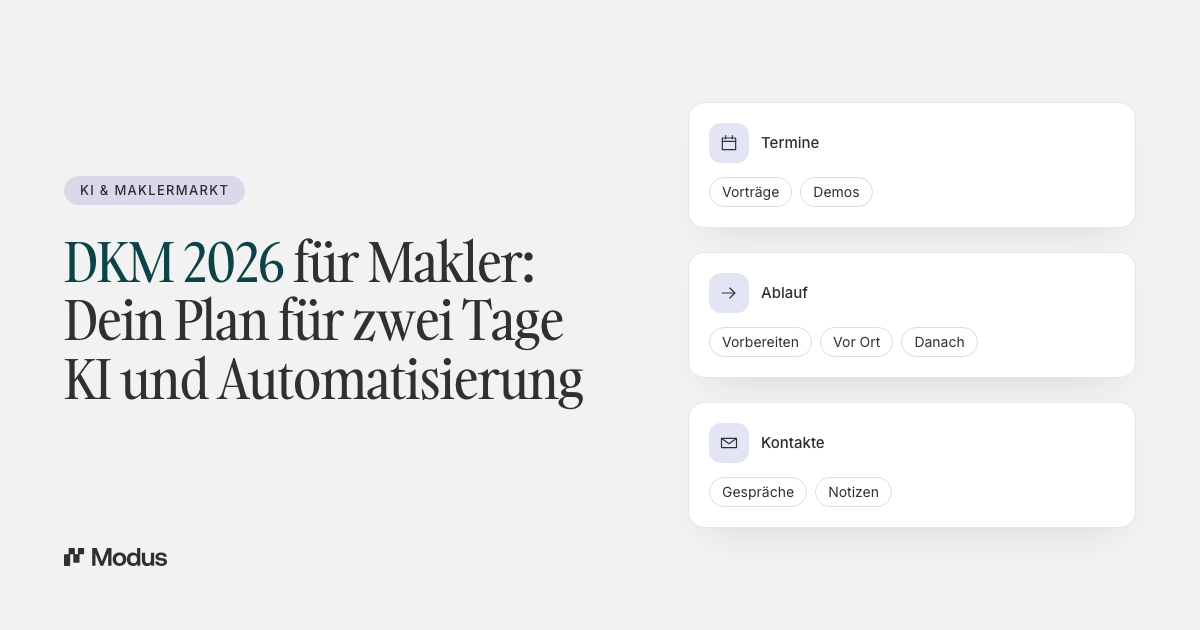
If automation is only as good as its foundation, then the real work is the foundation. In the brokerage, structure doesn't mean one more tool. It means that every incoming communication is turned into a clearly defined object before anything happens automatically.
Four elements make a case structured:
- Case type. Is it a claim, an enquiry, a cancellation, a policy change? Without this classification, no system knows what to do.
- Ownership. Who handles the case, who signs off? A task without an owner stays undone, no matter how much AI is involved.
- Priority. What is urgent, what can wait? Automation without prioritisation only produces a faster pile.
- Traceability. Who decided what, and when? Without a trail, no case is auditable, neither internally nor towards a regulator.
In its principles paper on big data and artificial intelligence, BaFin sets out exactly this requirement: data must be representative, high-quality and balanced, results must be traceable, and control must stay with people. That's not bureaucracy. It's the precondition for automation to be defensible at all.
Only once these four elements are in place does the AI have something meaningful to do. It then doesn't shift chaos around, but carries an orderly structure forward.
Straight-through processing without control: when no one is looking anymore
In the insurance world there's a technical term for a case running fully automatically without any human involvement: straight-through processing. Used correctly, it's a win. An address change that used to tie up 10 to 25 minutes runs through in under two minutes. Used wrongly, it's a blind spot.
The difference lies not in the technology, but in the control. Straight-through processing makes sense where the case is clearly defined, the data checked and the exceptions cleanly routed out. It becomes dangerous where it's pulled over unclear cases, because then no one notices anymore that something is going wrong.
An example from practice: a claim comes in, the system recognises the policy, checks the cover and automatically sends an acknowledgment with a settlement commitment. That sounds efficient. Until it turns out that the policy had a waiting period the model didn't know about, because it was never cleanly recorded in the dataset. The commitment is out, the client has it in black and white, and the correction costs more time and trust than the automation ever saved.
An honest rule helps: only automate what you can also spot-check. Anyone who lets a process run fully automatically without being able to trace it hasn't gained efficiency but handed off responsibility. And in intermediation, responsibility can't be delegated. It stays with the broker.
Shadow AI in the brokerage: the underestimated risk
While management is thinking about the right automation strategy, automation has long since arrived in the office. Just ungoverned.
Employees copy client data into ChatGPT to draft a reply faster. They upload a claims document into a free tool to have it summarised. No one ordered it, no one forbade it. This phenomenon is called shadow AI, and it's astonishingly widespread. According to a 2025 Cybernews survey, 59 percent of employees use unapproved AI tools at the workplace, often with sensitive company data.
In the brokerage, that's doubly delicate. It involves health data, financial circumstances, the course of claims. Anyone who puts this data into an uncontrolled tool risks a data-protection breach without noticing. And because every employee uses their own tool, the opposite of structure emerges: many small, undocumented automations that no one has an overview of.
You don't solve the problem with a ban that no one follows anyway. You solve it with a clear, approved structure that makes the detour via shadow AI unnecessary.
What regulation demands: clear responsibility instead of speed
The regulatory direction is unambiguous, and it points not at speed but at responsibility. The GDPR, the documentation obligations from the IDD and the European AI Act demand the same thing at their core: anyone who deploys data and AI must be able to demonstrate how and why.
The AI Act takes effect in stages and affects insurance brokers mainly as deployers, not as developers of AI. Which obligations concretely apply, which deadlines are relevant and which risk classes matter at all for a typical brokerage, we've analysed in detail in a dedicated post on the AI Act for insurance brokers.
For this context, only one point counts. BaFin makes clear that responsibility for the proper use of AI lies with the companies, not with the tools. Anyone who automates is liable for the result. This liability can only be carried if the cases behind it are structured and traceable. The regulator's requirement is therefore not at odds with automation. It's the same lever: structure.
Five warning signs that you're automating too early
Before you automate a case, an honest look at your own starting position is worth it. These five signs argue for working on the structure first:
- The same client data sits in several places. Broker management system, spreadsheets, email inbox. As long as there's no reliable source, you're automating on top of contradictions.
- No one can say who is responsible for a case type. Without clear owners, the automation runs right past responsibility.
- Exceptions are resolved by shouting across the room. If special cases are defined nowhere, the system can't route them out and processes them wrongly.
- There's no spot-checking. Anyone who doesn't regularly check what the automation does notices errors only when the client calls.
- AI is used but not documented. That's shadow AI, and it's a sure sign that structure is missing.
The more of these points apply, the more expensive premature automation becomes. The good news: every point is fixable, and specifically before the first tool goes live.
Structure before automation: the right order
The solution is not a rejection of AI. It's a question of order. Automation without structure is risky. Structure without automation is inefficient. It only becomes valuable in the right sequence.
Three steps lead there:
Define your cases. Determine which case types exist in your office and which data, responsibilities and steps belong to each. That's work on the model, not on the technology.
Structure the intake. Make sure every incoming communication, whether email, document or message, is automatically assigned to the right case type, with ownership and priority. This is where the leverage begins.
Then automate. Only on this orderly foundation do you automate the routine. The person reviews and signs off, the system executes. Not the other way around.
In practice this doesn't mean planning for half a year before anything happens. It means fully ordering a single case type, then automating it and afterwards transferring the pattern to the next one. Start small, start clean, then scale.
This very order is the difference between a tool that speeds up individual tasks and an operational infrastructure that changes how work comes into being. Whoever structures first and automates second wins twice: fewer errors and more speed. Whoever reverses the order gets neither.
This is also the economic core. Why operational leverage changes the brokerage more than any new hire, and why growth today no longer comes from the number of employees, rests on the same precondition: the operational base has to be right. No structure, no leverage.
Frequently asked questions
What risks does AI carry in insurance?
The biggest risks arise not from the AI itself, but from its use on a poor foundation: faulty or contradictory data, unclear responsibilities and a lack of control. Add to that data-protection risks with sensitive client data and the danger that automated decisions repeat existing errors on a large scale. Structured cases and human sign-off significantly reduce these risks.
What is meant by straight-through processing?
Straight-through processing refers to a case running fully automatically without manual intervention. For clearly defined standard cases, such as an address change, that makes sense and saves time. For unclear or complex cases it's risky, because errors run through unnoticed without human control. What matters is that exceptions are cleanly routed out and spot-checks remain possible.
What does data quality mean in the brokerage?
Data quality means that client data is complete, up to date, free of contradictions and maintained in one reliable place. If the same data is kept in parallel in several places, quality drops, and every automation on top of it multiplies the errors. Good data quality is the precondition for AI to be able to work reliably in the brokerage at all.
What is shadow AI and why is it a problem?
Shadow AI is the ungoverned use of AI tools by employees, without approval and without documentation. The problem is twofold: sensitive client data can end up in uncontrolled systems, and many small, untraceable processes emerge instead of one consistent structure. The remedy is not a ban but an approved and genuinely usable alternative.
When is automation worth it in the brokerage?
Automation is worth it where a case occurs often, is clearly defined and rests on checked data. Standard cases like address changes or policy queries are a good fit. Complex advice and one-off cases don't belong in full automation. The rule of thumb: only automate what you can also spot-check.
Do I have to have all my data perfect before I automate?
No. Perfection is not the goal, order is. It's enough to start with the most common case type, structure it cleanly and only then automate. On that foundation, you can expand step by step. What matters is the order: structure first, automation second, not the other way around.
Conclusion
Automation is not an end in itself and not a shortcut. It's an amplifier. On an orderly foundation, it makes a brokerage faster, more reliable and auditable. On a disorderly foundation, it only makes it wrong faster.
The order decides. Whoever structures their cases first, clarifies responsibilities and secures traceability can then automate without losing control. Whoever skips the structure automates their risk right along with it.
Scale revenue. Not headcount.
Don't miss any developments in AI for insurance brokers. Sign up for updates now.