Why the next generation of brokerages won't grow through headcount
67% of insurance brokers are over 50. One in three will stop within 15 years. Why modern brokerages rely on operational leverage instead of headcount.
By Daniel D.
Modus
Last updated: May 25, 2026
News & InsightsA brokerage with 400 clients has been looking for an in-house administrator for eight months. The role is advertised, the salary is at market rate, the location is well connected. Even so: not a single qualified application. The owner is now working 55-hour weeks. She can no longer take on new clients.
This is not an isolated case. It's the reality in thousands of German brokerages.
For years the dominant thesis in the industry has been: without back-office staff there's no growth. More clients need more employees to process cases, file documents, answer requests. Anyone who wants to scale has to hire.
That thesis no longer holds. And the insurance brokers who set the course right now will prove it.
The starting point: 46,000 brokers, average age 54
The numbers are unambiguous. According to the AfW Vermittlerbarometer, the average age of German insurance intermediaries is 53.7. 67.2 percent are over 50. Only 4.4 percent are under 30.
What that concretely means:
- One in three intermediaries will stop within the next 15 years
- 50 percent of the current intermediary base will retire within 20 years
- 85 percent of brokers have no arranged succession
- According to BearingPoint, one in four brokers will disappear from the market by 2030
This is not a gradual shift. It's a structural upheaval that will reorder the entire industry over the next five to ten years.
For the brokers who stay or start out fresh, this creates a historic opportunity: more portfolios coming free than ever before. More clients looking for a new broker. But also the question: how do you serve these portfolios when the employees no longer exist?
The old growth model: more clients, more staff
The classic growth model in broker distribution is about as simple as it gets: a broker acquires clients. Beyond a certain portfolio size he needs back-office staff to take over the administration. Filing policies, reporting claims, checking premium invoices, documenting policy changes. Anyone who wants to grow further hires more employees. That's how it's worked for decades.
The problem: this model scales linearly. Every new employee costs salary, onboarding, infrastructure. The margin per client falls with every head added. And a significant part of the newly hired capacity flows not into revenue work but into administration.
The BearingPoint young-broker study 2025 demonstrates this strikingly: 60 percent of young brokers' working time does not go into advice. It goes into administration, documentation and operational coordination. Only 25 percent of advisory processes are documented and standardised at all.
That means: of every new hire, more than half the capacity flows into activities that generate no direct revenue. The back-office employee you hire spends their time sorting incoming emails, transferring data between systems and following up with insurers. Necessary work. But not value-creating work.
Why the old model no longer scales
Even if the old model still worked in business terms: the labour market no longer allows for it.
30 percent of training positions in the insurance and finance sector go unfilled. That's reported by Versicherungsbote, citing current DIHK data. The insurance industry has an attractiveness problem, especially among young career entrants.
Three factors sharpen the situation:
1. Regulatory complexity. Over 80 percent of young brokers name regulation as their biggest challenge. IDD documentation requirements, GDPR, the AI Act taking effect from August 2026. Every new rule increases the administrative effort per case. More regulation requires either more staff or smarter systems.
2. Salary competition. Qualified back-office administrators earn 38,000 to 48,000 euros in urban regions. For a brokerage with 500 clients and an average portfolio commission of around 250 euros per client per year, every additional full-time position is a noticeable dent in the margin.
3. Generational change. The incoming generation has different expectations of a workplace. Remote capability, digital tools, meaningful work. "Filing policies in folders" is not a convincing job ad. The industry competes with tech companies and consultancies for the same profiles. And it's losing.
Telling: only about one in seven young brokers would recommend the profession without reservation. That's not a perception problem. That's a structural problem.
The result: anyone who wants to hire today finds no one. And anyone who does find someone pays more for a capacity that half disappears into non-value-creating work.
The decisive lever: technology instead of headcount
The brokerages that will win in this market think about growth in a fundamentally different way. That has little to do with the owner's age and a lot to do with how they do the maths.
They don't ask: "Who can I hire?" They ask: "What can I automate?"
This paradigm shift shows especially clearly in newly founded offices. The BearingPoint young-broker study 2025 demonstrates: these offices build their own administrative structures less often and more frequently use existing platforms and technology solutions as their operational base. That shifts the lever from building headcount to choosing infrastructure. But the approach isn't tied to a founding year. Any office can adopt it, regardless of how long it's been in the market.
The technology that makes this possible already exists. AI systems can analyse incoming communication, classify cases, assign tasks and prepare replies. The human reviews and signs off. This isn't a vision of the future. It's the operational state of play at brokerages already working with AI infrastructure today.
The decisive distinction here: this isn't about a single AI tool that speeds up one task. It's about an operational infrastructure that changes the entire flow of work. From the incoming email to the reply that's sent. From the claim report to the documentation in the management system. If only individual steps are automated, the human still stays tied up in every case. Only end-to-end automation creates the lever that decouples growth from staffing needs.
| Old model | New model |
|---|---|
| In-house back office for administration | AI-supported case handling |
| Manual email sorting | Automatic classification and assignment |
| Individual claim intake | Structured case creation by the system |
| Headcount growth proportional to clients | Technology leverage decouples growth from headcount |
| Caseworker roles | Reviewer and decision-maker roles |
What modern brokerages do differently
The differences from the established market are measurable:
Digitally set up instead of paper-based. Modern offices rely on digital tools rather than filing folders. Management systems, digital signatures, automated client communication are not an add-on but the foundation.
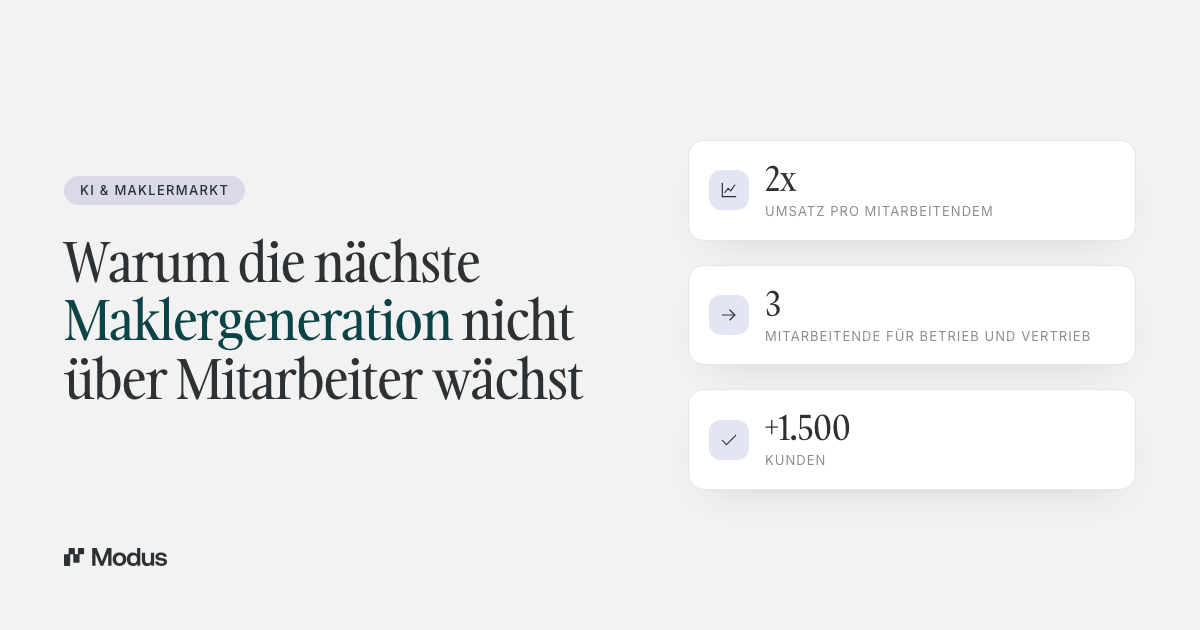
Small and efficient instead of large and staff-intensive. The growth strategy isn't: "When do I hire the next employee?" But: "How do I manage to serve 500 clients with three people instead of seven?"
Infrastructure as a decision, not a purchase. Instead of collecting individual tools, these offices choose an operational base on which all cases come together. Not ten island solutions, but one layer that takes in incoming communication, structures it, and turns it into clear cases with an owner and a priority.
According to Versicherungsbote, 85.3 percent of surveyed brokers complain about excessive waiting times with insurers and 72.6 percent about slow claims handling. This frustration with the status quo drives the search for technological solutions. It's not a generational theme. Every office working daily against manual processes sooner or later looks for a better operational base.
Revenue per employee as the new metric
In the classic broker model, success is measured by portfolio size, number of contracts or revenue. These metrics aren't wrong, but they tell only half the story.
The more relevant question is: how much revenue does each employee generate? Revenue per employee makes visible the difference between a staff-intensive and a leverage-based business model.
A worked example:
Office B serves the same number of clients with half the staff. Not because the employees type faster. But because repetitive tasks (sorting, assigning, standard communication) are taken over by the system.
The consequence: Office B can grow without building up staff proportionally. Every new client raises revenue without burdening the cost structure to the same degree.
That's the economic core of the change. Not efficiency. Not digitalisation. But operational leverage. The ability to generate more value creation per head. Not through faster work, but through structurally less manual work per case.
In an industry where 85 percent of brokers have no arranged succession, revenue per employee becomes an existential metric. Anyone who can serve more clients per employee can take on more portfolios. Anyone who can take on more portfolios grows faster. Anyone who grows faster becomes the more attractive successor for the departing generation.
| Metric | Firm A (traditional) | Firm B (leverage-based) |
|---|---|---|
| Clients | 800 | 800 |
| Employees | 8 | 4 |
| Portfolio revenue (at €250/client avg.) | €200,000 | €200,000 |
| Revenue per employee | €25,000 | €50,000 |
| Personnel costs (estimated) | €320,000 | €160,000 |
| Margin before other costs | negative | €40,000 |
What this means for the industry: broker market 2030
The BearingPoint study "Broker Market 2030" forecasts that one in four brokers will disappear from the market within the next few years. Consolidation will accelerate. The question is not whether this change is coming. The question is who benefits from it.
Three scenarios are taking shape:
1. Platform consolidation. Large platforms and insurance-tech providers take over operational functions that every office previously handled itself. Brokerages become leaner and focus on the client relationship and advice. The platform supplies the operational infrastructure.
2. The two-tier structure. Offices that invest in AI infrastructure will be able to serve more clients with fewer staff. Offices that cling to the old headcount-growth model come under cost and competitive pressure. The gap widens. Not because one side advises better, but because one side produces at a structurally lower cost.
3. The structural break. Technology-supported offices take over the portfolios of departing brokers, integrate them into lean structures and serve them with a fraction of the previous staffing effort. That changes the cost structure of the entire industry.
Job profiles with an AI element in the insurance industry have risen from 5 to 21 percent within a year. The change is happening. The question is not whether, but how fast.
For brokerages active today this means: the next three to five years decide which side of the two-tier structure you're on. Anyone who switches their operational base to technology now has a structural advantage that grows over time. Anyone who waits will have to invest more later and compete against already optimised rivals.
Conclusion: the future belongs to leverage, not headcount
The future of the insurance broker won't be determined by the question of who has the most employees. It will be determined by the question of who achieves the greatest operational leverage.
The demographic reality allows no other conclusion: with 67 percent of intermediaries over 50, 30 percent of training positions unfilled and 85 percent of successions unarranged, growth through headcount has structurally reached its end.
The next generation of brokerages will be smaller. But not weaker. These offices work differently: technology-supported, optimised for revenue per employee. Not out of conviction, but because the market forces it.
The good news: the tools exist. The portfolios are coming free. And anyone who sets up the operational base right today builds a lead that grows larger with every year.
Scale revenue. Not headcount.
Frequently asked questions
How many insurance brokers are there in Germany?
There are currently around 46,771 insurance brokers registered in Germany. The average age is 53.7. 67.2 percent are over 50, only 4.4 percent under 30. The industry faces a considerable generational change.
Why is there a shortage of young talent among insurance brokers?
Several factors: 30 percent of training positions go unfilled. The industry has an attractiveness problem among young career entrants. High regulatory requirements (IDD, GDPR, the AI Act) make entry complex. At the same time, other industries offer comparable salaries with a lower regulatory burden.
How can a brokerage grow without hiring new staff?
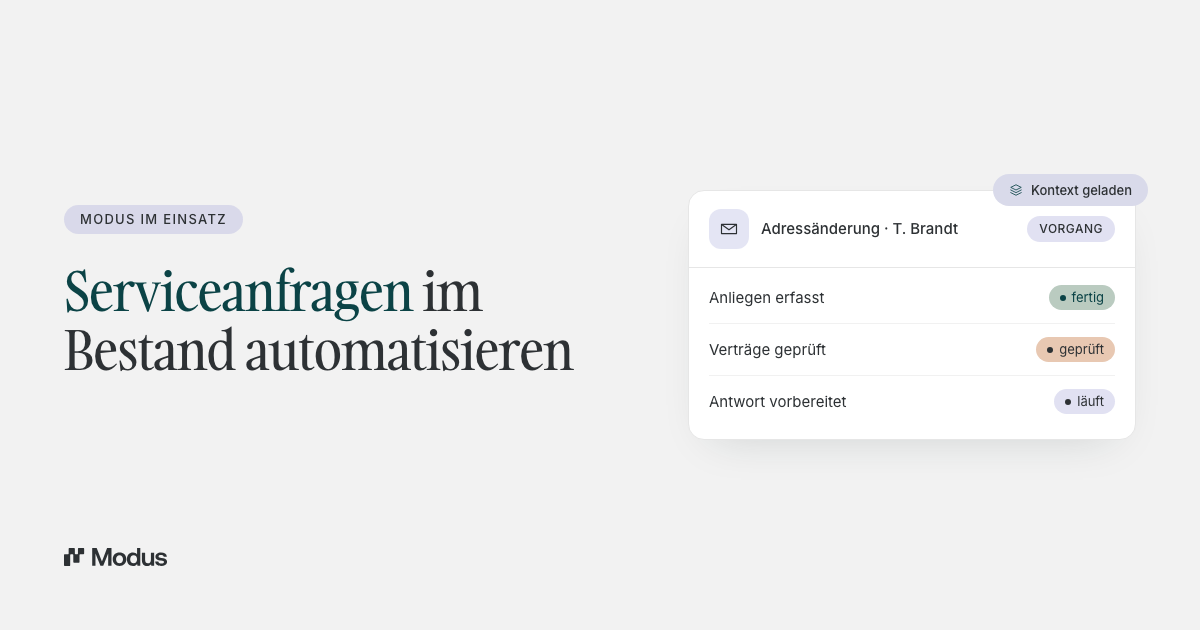
Through operational leverage: AI-supported case processing reduces the manual effort per client. Platforms take over operational functions. Standard cases (address changes, policy enquiries, initial claim reports) are automated. The human reviews and signs off, instead of building up every case themselves.
What percentage of working time do brokers spend on administration?
According to the BearingPoint young-broker study 2025, 60 percent of working time goes not into advice but into administration, documentation and operational coordination. In established offices the administrative share is sometimes even higher, at 60 to 80 percent.
What does the broker market look like in 2030?
BearingPoint forecasts that one in four brokers will disappear from the market by 2030. The industry is consolidating towards a platform economy: leaner offices, more technological infrastructure, fewer purely person-based models. Brokers who invest in AI infrastructure will be able to serve larger portfolios with smaller teams.
Is it still worth becoming an insurance broker?
Yes, under changed conditions. The retirement wave creates an oversupply of portfolios coming free. Anyone who relies on a technology-supported, lean structure can take on and serve these portfolios economically, without growing staffing effort proportionally. The business model is attractive if the cost structure is right. The decisive lever is not the number of clients, but revenue per employee.
Don't miss any developments in the field of AI for insurance brokers. Sign up for updates now.