What AI costs in the brokerage and when it starts to pay off
What AI costs in the brokerage, from assistants starting at around 20 euros per user to an operational platform, and when it pays off: with cost types, price ranges and a simple calculation you can rerun with your own numbers.
By Daniel D.
Modus
Last updated: Aug 6, 2026
News & InsightsThere's a quote for an AI solution on your desk. One number per workstation per month, next to a list of features. And the question every owner asks at this point: does this pay off for a business like ours?
The honest answer: the list price alone can't answer that question. Two tools, both called "AI", can differ in price by a factor of ten, and the more expensive one can still be the far better deal. This article sorts out the cost of AI in the brokerage: which cost types actually apply, what the market is charging in 2026, and how a simple calculation shows you when it's worth deploying in your business.
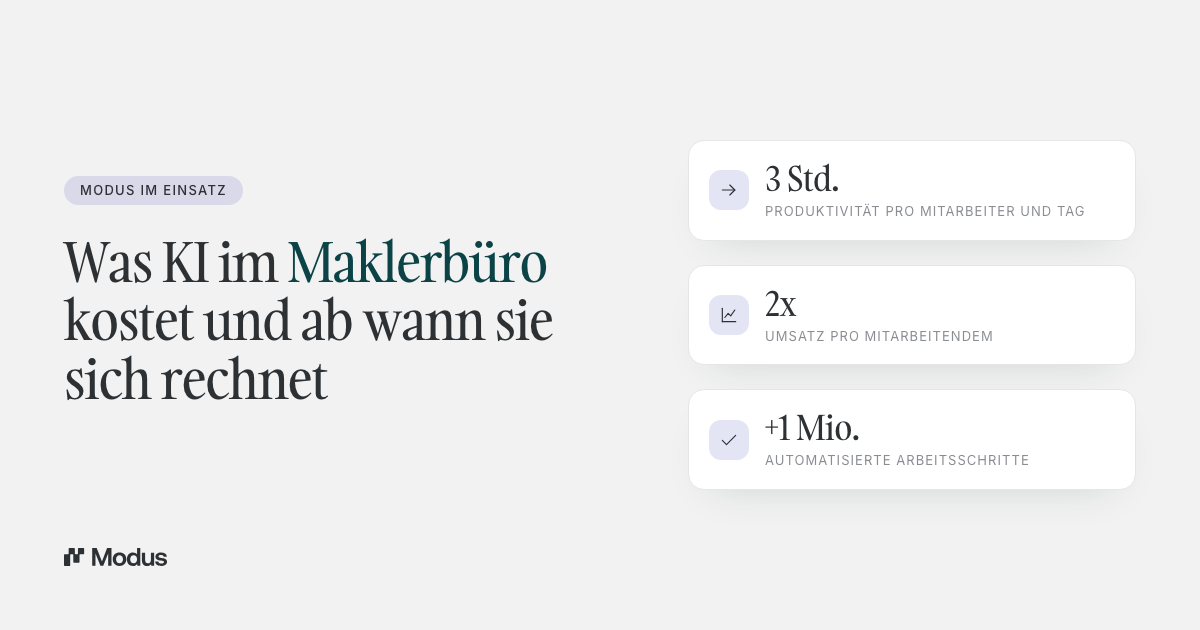
In short: AI software for insurance brokers costs somewhere between around 20 euros per user per month for general assistants and individually calculated per-workstation pricing for specialised platforms. What matters, though, isn't the list price but the time recovered per employee. Even one hour a day per employee amounts, in a ten-person office, to a capacity value of around 88,000 euros a year. Measured against that, the software is rarely the biggest line item.
Which cost types actually apply
Anyone who looks only at the licence price underestimates one half of the calculation and overestimates the other. In practice, the costs break down into four blocks.
1. The licence. The most visible line item: a price per user or workstation per month. It's low for general tools and higher for specialised platforms, for one simple reason: a general assistant gives you text, a specialised platform takes over steps of the work. More on that shortly.
2. Setup and integration. A solution meant to work with your management system, Outlook and your channels has to be connected. This effort is a one-off, and it largely determines whether the solution holds up day to day. A rule of thumb from our own experience: the closer the software works to your existing systems, rather than replacing them, the smaller this block. A switch that isn't a migration project but a matter of days costs correspondingly little.
3. Onboarding and change. The most frequently underestimated line item. Not because the software is hard to use, but because ways of working change. A structured start over four weeks, in which the team makes the new way of working a habit, is realistic. This time is an investment, not lost time, but it belongs in the calculation.
4. The hidden line items. Three things appear in no quote and cost money anyway:
- Switching costs and lock-in. An AI deeply anchored in a single management system or pool moves with it when you switch. What looks cheap today can make a later system change expensive.
- Data-protection setup. Client data belongs only in a solution with a data-processing agreement and processing in the EU. A free consumer account doesn't meet that, and retrofitting it costs either money or, in the worst case, considerably more.
- Compliance. Since 2 August 2026, the EU AI Act's transparency obligation applies in client-facing contact. What brokerages should have prepared for it is covered in "The EU AI Act from August 2026: what insurance brokers need to prepare now".
Price ranges in the 2026 market
The market for AI in the brokerage is hard to survey, and so are the price ranges. Broadly, it sorts into three tiers.
General AI assistants. ChatGPT in its business version starts at around 20 euros per user per month with annual billing (as of August 2026). Microsoft 365 Copilot ranges, depending on the variant, from 15.60 to 28.10 euros per user per month, each on top of the required Microsoft base licence. In return you get a strong tool for drafting, summarising and researching. What you don't get: software that knows your business. Every case is built by hand, every piece of context copied in manually.
AI features in the management system. Many management-system vendors add AI modules for an extra fee. Prices vary widely and are often tied to the vendor's overall package. The advantage: proximity to your portfolio data. The drawback: the AI is tied to the vendor and usually narrowed to a single channel.
Specialised platforms and operational systems. Solutions that work as a layer on top of the management system and turn incoming communication into structured cases are calculated per workstation and by scope, and offered on request. That applies to Modus too. There's a simple reason no list prices appear on the website here: the scope depends on team size, channels and connected systems.
The most important point of this overview: the three tiers are not the same product at different price levels. An assistant for 20 euros speeds up drafting. An operational layer takes over recognising, assigning, structuring and preparing entire cases. A price comparison only makes sense when the scope of what's delivered is comparable. We described the architecture behind these tiers in the overview "AI software for insurance brokers: what it does and what matters in 2026".
When AI pays off: the calculation
Now to the real question. Whether AI pays off isn't decided on the price list but on your team's timeline.
How much tied-up time there is to recover is clear from a look at the industry: according to the AfW broker barometer, almost one in two brokerage firms (45.7 percent) spends a full working day per week on regulatory work alone, and more than a quarter spend even more. On top of that comes the operational day-to-day: sorting, assigning, searching, documenting. A bureaucratic burden that many brokers now describe as a threat to their survival.
The calculation itself is simple. You need four values:
Recovered hours per day per employee × number of employees × working days per year × hourly cost = capacity value freed up per year
An example for an office with ten employees. We deliberately calculate conservatively with one hour a day per employee. That's the low end of what we already see in our own brokerage in the early phase, where it's one to two hours. As the hourly cost we use 40 euros in fully loaded employer cost for back-office staff.
Read the other way around: for this calculation to flip, the solution for the ten-person office would have to cost more than around 730 euros per workstation per month. Standard market prices are well below that, in each of the three tiers.
The same calculation also works for smaller businesses, only with different consequences. An office with three employees, at one hour a day per person, arrives at around 26,400 euros of freed-up capacity per year. That sounds like less, but it weighs more: in a small team there's no one to delegate administrative work to. Every tied-up hour is missing directly from advice, and an additional position is rarely a realistic option at this size. The relative leverage in a small office is therefore often greater than in a large one.
In fairness, three things belong with this calculation:
First: this is a calculation model, not a verified measurement. The values are assumptions you should replace with your own. Count for a week how much time in your business goes into sorting, assigning and searching, and calculate with that figure.
Second: freed-up time is capacity, not yet revenue. The 88,000 euros aren't in the bank. They only turn into earnings once the time gained flows into advice, portfolio development and new business rather than into an earlier end to the day. That's exactly why introducing AI always comes with the decision about what the freed-up time will be used for.
Third: the calculation assumes the time really does come free. A tool that only speeds up one sub-step while the rest of the case runs by hand frees up considerably less than the list price promises. Which brings us to the question of how you recognise real leverage.
| Value | Assumption |
|---|---|
| Time recovered | 1 hour per day and employee |
| Team | 10 employees |
| Working days | 220 per year |
| Hourly cost | €40 (fully loaded employer cost) |
| Value of capacity freed up | €88,000 per year |
Why revenue per employee is the right metric
The cost question has a bigger sibling: which metric do you use to measure whether the investment paid off?
Our answer: revenue per employee. This figure shows whether your business has operational leverage or just more heads. When the same employees handle more cases because recognising, assigning and preparing run in a structured way, revenue rises without staff costs growing at the same pace. The difference lands in the margin.
In this logic, AI costs are not a software expense but an investment in exactly this metric. A business that spends 500 euros a month on tools and thereby frees up the equivalent of half a position in capacity has a better deal than a business that spends 20 euros and changes nothing about its structure. How to calculate and interpret the metric is covered in "Revenue per employee: the north star brokerages should be measured against".
The reverse also holds, by the way: anyone who solves the capacity problem with additional staff pays permanently. An additional back-office position costs a multiple of any software licence, needs months of onboarding, and is hard to fill in a swept-clean labour market. Why growth through headcount runs into structural limits is described in "The capacity traps of brokerages".
How to recognise a real ROI
Not every AI expense pays off. Three criteria separate an investment from yet another tool subscription.
Structure before automation. The biggest lever isn't faster drafting but the intake point: every message recognised, assigned to the right client, structured as a case with an owner. Anyone who automates on an unsorted basis mostly speeds up the errors already sitting in the data. Why this order matters especially in insurance is covered in "Why automation without structure is dangerous in insurance".
Integration instead of an isolated solution. A solution that replaces your management system and Outlook creates migration costs and friction. A solution that sits as a layer over the existing systems and works with them keeps the setup costs small and the freedom to switch large.
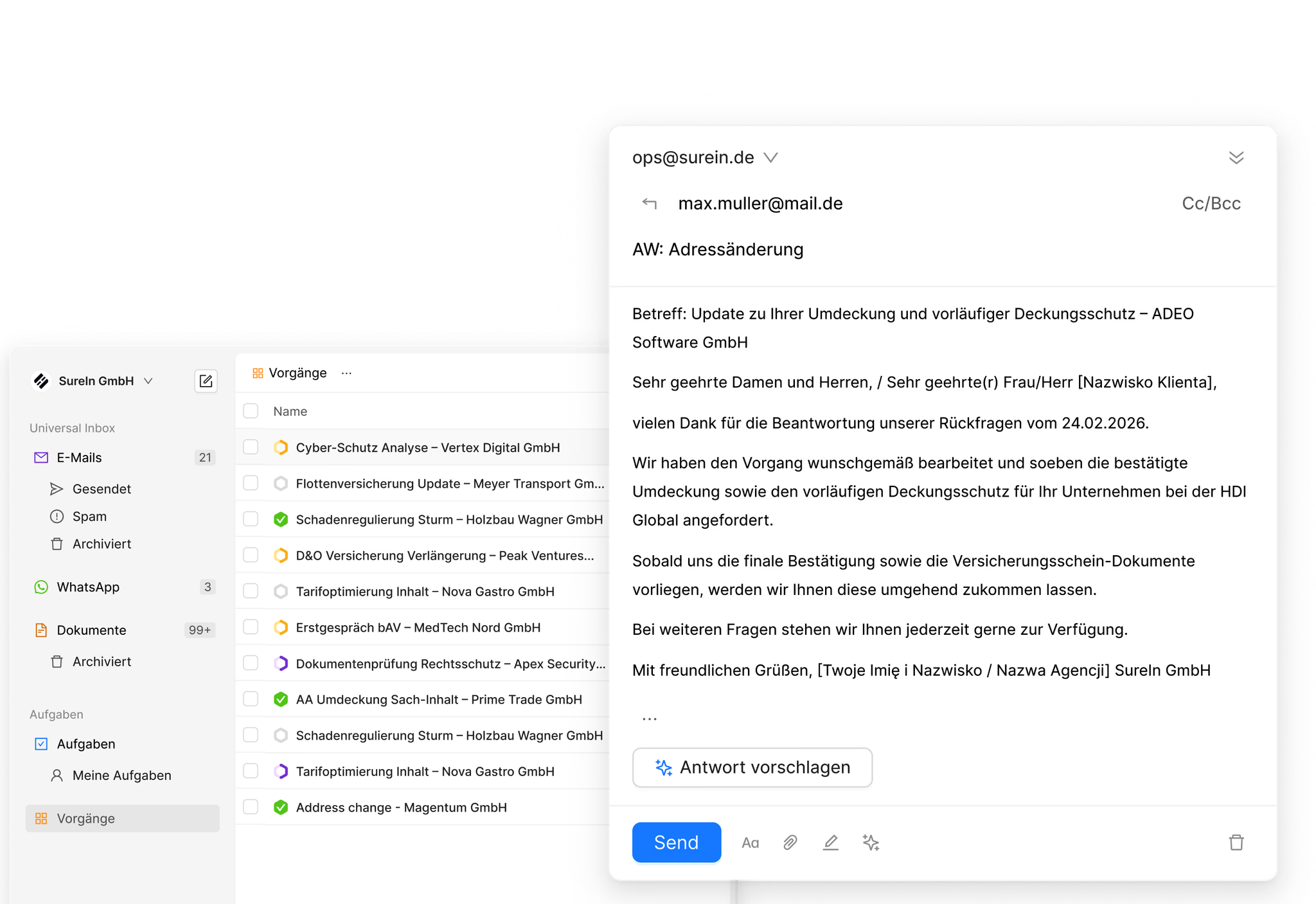
Measurability and traceability. A real return shows up in concrete cases: how long an address change takes before and after introduction, how many cases the team handles per day, how many are left undone. A documented timeline per case makes that measurable. In our own business, for example, this measurement showed that a standard case like an address change drops from 10 to 25 minutes down to one or two minutes, because searching, assigning and drafting have been prepared.
And one limit belongs to honesty: AI replaces neither the advice nor the professional decision. It prepares, the broker reviews and signs off. The economic effect arises not because people are eliminated but because the same people can direct their time to the work that generates commission.
Frequently asked questions
What does AI software for insurance brokers cost?
General AI assistants like ChatGPT Business start at around 20 euros per user per month; Microsoft 365 Copilot ranges from 15.60 to 28.10 euros plus the base licence (as of August 2026). AI modules in the management system are calculated as an add-on to the package. Specialised operational platforms are offered per workstation and by scope, usually on request.
What does Modus cost?
Modus is calculated per workstation and offered on request, because the scope depends on team size, channels and connected systems. The fastest way to a reliable figure for your business is a demo with our team.
How much time does AI really save in the brokerage?
In our own brokerage we see one to two hours per employee per day freed up as early as the initial phase, because intake arrives structured. The exact figure depends on the share of recurring service cases and the degree of integration. What matters is measuring before and after on the specific case type.
Is AI worth it for small brokerages too?
Especially there. The smaller the team, the more every tied-up hour eats into advisory time, and the less often the problem can be solved with an additional position. Even with two or three employees, one hour a day per person equals the value of a quarter to half a position.
How quickly will I see an ROI?
For clearly defined, frequent case types, the time gain shows up in the first few weeks, because the daily routine immediately runs more structured. The full effect emerges once several case types are mapped and the freed-up time is deliberately steered into advice and portfolio development.
Conclusion
The question "What does AI cost in the brokerage?" is quickly answered: from around 20 euros per user per month up to individually calculated platform prices. The more important question is: what does it cost to change nothing? A business in which every employee loses an hour a day to sorting, searching and assigning pays a five-figure sum in tied-up capacity for it every year, just invisibly.
This is exactly where Modus comes in. As an AI-native operating system on top of the management system, it structures the incoming work, prepares cases and makes the effect measurable on the timeline. You can run the calculation with your own numbers. And wherever the assumptions in this article don't fit your business, replace them: the model stays the same, and so does the leverage.