What we learned about inbox stress from 2,000 SureIn clients
2,000 clients, 3 to 4 people in the brokerage, one inbox. What we learned about inbox stress in brokerages: the pace is set by the distribution of tasks, less by the volume.
By Daniel D.
Modus
Last updated: Jul 21, 2026
News & InsightsWe run a brokerage ourselves. That's where this number comes from.
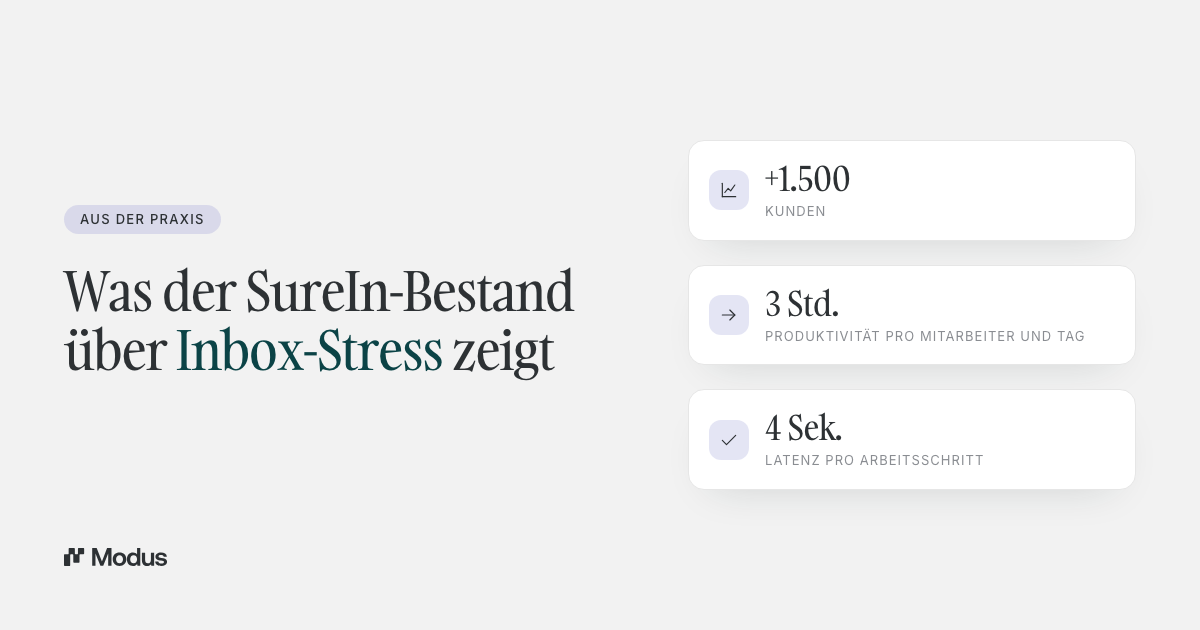
At SureIn we look after just under 2,000 clients, and the brokerage itself runs with 3 to 4 people. In total we're 13, the bulk of them building Modus as a development team. This is not an industry study and not an aggregated report from clients who sent us their numbers. It's our own inbox, our own organisation, our own operational reality.
One clarification up front, because otherwise the number sounds wrong. The just under 2,000 clients are SureIn's end customers, not 2,000 surveyed brokerages. This is about the inbox that a single brokerage with 3 to 4 people in its operational team handles every day. That's exactly what makes the data relevant. It shows what a real business looks like when you measure it honestly instead of estimating it.
We stopped counting emails. We measure where the time goes.
The usual reflex is to count volume. How many emails a day, how many documents a week, how many cases a month. These numbers aren't wrong, but they're the wrong tool. They tell you how much comes in. They don't tell you why the day is harder than the sheer volume would suggest.
So over six months we measured something different. Not how much comes in, but which task the time actually flows into. Eight workflow types, the same ones every month: quote, appointment and advice, claim, service, email, research, application, queries. For each we recorded how many hours it tied up per month.
The result disproved our own assumption.
Two workflows carry half the operational time. Email isn't one of them.
It isn't the inbox as sheer volume that's the most expensive part. It's two workflows. Quote creation at around 57 hours a month, and preparing appointments and advice at around 53 hours. Together they carry more than half the measured operational time. Pure email handling, the thing that feels loudest day to day, comes in at around 16 hours.
Here's how the time is distributed across the eight types:
There are two ways to read this, and both matter.
The time reading: quote, advice, claim and service together tie up around three quarters of the hours. Anyone who structures these workflows structures the largest part of their business.
The pain reading: the claim ties up only 23 hours, but it's the task with the highest pressure. Responses from insurers stay open for weeks, the client follows up, and no one can say off the top of their head where the case currently stands. Time and pain are not the same thing. Anyone who counts only hours underestimates the claim. Anyone who counts only pain misses that quote creation quietly ties up the most capacity.
The concrete figures come from our own business and are indicative, not an industry benchmark. What's robust is the shape behind them. A small number of workflows carries the largest part of the time, and the most expensive ones are rarely the ones that feel loudest.
| Workflow | Hours per month | Share |
|---|---|---|
| Quote | 57.5 | 28% |
| Appointments and advice | 53.2 | 26% |
| Claim | 23.0 | 11% |
| Service | 18.6 | 9% |
| 15.7 | 8% | |
| Research | 14.1 | 7% |
| Application | 12.6 | 6% |
| Follow-up questions | 8.0 | 4% |
Quote creation: the most expensive workflow, because every request starts from scratch.
Quotes are the single biggest item in our measurement. The reason lies not in the calculation itself but in everything before it. A request comes in, often incomplete. Someone gathers the risk data, checks the portfolio, clarifies missing details, obtains comparisons and prepares everything for the client. Every request is effectively rebuilt from scratch, even when the business is handling the same type of quote for the hundredth time.
That's exactly why this workflow scales so poorly. More requests mean almost proportionally more hours, because little is reused from one case to the next. Anyone who structures quote creation tackles the most expensive point in the day.
Appointments and advice: the time is in the preparation and follow-up, not the conversation.
The second-biggest item is surprising at first glance, because advice is exactly the work a broker is paid for. The point is a different one. A large part of these 53 hours flows not into the conversation but into preparing for it. Gathering context from email threads, management-system notes and old cases, reconstructing the status, sorting documents before the appointment even begins.
On top of that comes the follow-up, and it's regularly underestimated. After the conversation, results have to be documented, agreed changes set in motion, tasks distributed and commitments translated into follow-up reminders. The management system needs updating afterwards. This work shows up in no calendar, but it belongs to those same 53 hours.
No one automates the conversation itself, and that isn't the goal. The lever is in the preparation and follow-up. When a client's full context sits in one place, time shifts from gathering back into advising. And when structured cases arise directly from the appointment, with an owner and a follow-up reminder, the follow-up no longer disappears into loose manual work either.
Claim: few hours, highest pressure, spread across three channels.
The claim is the type of task where the multi-channel nature of a brokerage shows most clearly. A photo comes in by WhatsApp from the client, a query from the insurer by email, a note lands in the management system after the phone call. Three channels feed into one case, with no shared status. Anyone picking the case back up after three days has to reassemble it from several fragments.
The real burden lies not in the processing but in the reconstruction. What's the latest status, what did the insurer last ask, is the invoice already in. That's why the claim, at only 23 hours a month, is still the task with the highest pressure. The client follows up, the case counts internally as open, but no one can see at a glance where it stands. That has nothing to do with diligence and everything to do with a lack of structure at intake.
Per case we see 10 to 25 minutes of manual effort. Structured, 1 to 2 minutes are enough
The spread between 10 and 25 minutes is real. What's responsible for it is the lack of structure at intake; it has little to do with the sheer volume coming in. A case that arrives cleanly assigned can be handled in a few minutes. A case that first has to be reconstructed from three channels burns twenty minutes before the actual professional work even begins.
Anyone who honestly measures what happens on a normal working day sees the same finding again and again. The largest share of manual work consists of searching, assigning and restoring context. The actual processing makes up only a small part. The professional work is often the smallest part of a case. The largest part is the path to it.
In our own business we've seen the same type of case shrink to 1 to 2 minutes with structured groundwork. The processing itself doesn't get faster; the groundwork simply falls away. The case is there, assigned, with clear ownership, clear priority, clear history. The employee opens it, checks, acts. The searching, assembling and reconstructing is gone.
This difference is the real lever. It depends less on how fast employees work than on whether the inbox was structured before anyone touched it. Anyone who structures the inbox doesn't just save two minutes per case. They win back the twenty minutes that previously disappeared into the groundwork.
Aggregated, that's up to three hours per employee per day.
When you extrapolate this difference across all task types, all employees and all days, you arrive at an order of magnitude that surprised us ourselves. Up to three hours per employee per day. This figure isn't hypothetical. It comes as an aggregated observation from our own business.
These three hours weren't visible before. They didn't sit in one big task you could pin them to; they were spread across hundreds of small moments of friction. A minute here, three there, five minutes picking a case back up after an interruption. No one feels the individual minutes; everyone feels the sense that the day was full and yet little professional work got done.
What's striking about these three hours is less their existence than the question of what happens to them once they're freed up. This time doesn't flow back into more processing of the same cases. It shifts from administration to portfolio growth. Time that vanished into administration becomes time for advice, for portfolio growth, for appointments.
That's exactly the point that makes the whole lever visible. This is less about efficiency gains than about shifting work that generates no revenue towards work that does. Anyone who structures the inbox doesn't just gain time. They shift their day.
The operational layer on top of the management system, instead of yet another inbox.
At this point the question of what that concretely means is fair. In our own business we started laying a layer over the existing system that takes on exactly this structuring at intake. This layer is called Modus.
Modus is not an additional inbox and not a new platform where all the emails that are already in Outlook land once more. It doesn't replace the management system as a system, and it doesn't make the system landscape more complex. Modus is an operational layer that sits on top of the existing management system and consolidates, structures and translates incoming communication into clearly defined cases.
The logic behind it is simple. Incoming communication is summarised, structured and translated into execution. This happens across all channels, from email through WhatsApp to BiPRO. The result is a different way of seeing work. Instead of a pile of inbox, cases sit ready, with an owner, a priority and traceability from the very start.
One clarification we often have to make, because the expectation is different. Modus is neither a management system nor a CRM, nor is it an AI assistant you chat with, and it isn't an add-on that makes an existing feature a little faster. Modus is the architecture that's missing when the management system is built for administering the portfolio and the intake comes from outside. Modus fits exactly into that gap.
One point that for many brokerages is the real differentiator. Modus is pool-independent. It isn't tied to a particular pool, and it also works when a brokerage runs several management systems in parallel. For a brokerage thinking today about a pool switch, multi-pool strategies or a management-system migration, that's a structural advantage. The operational layer stays stable, even when something changes beneath it. Switches on the pool or management-system side change the connection; the logic of the layer itself remains untouched.
Three hours per employee is less an efficiency topic than a growth topic.
If you read the three hours per employee per day as an efficiency gain, you've understood half of it. The other half lies in the question of what that time is used for. Anyone who structures the inbox before someone touches it scales revenue per employee instead of headcount budget. That's the real difference.
Brokerages that want to grow often face the same decision. Either hire more staff to cope with the rising intake, or structure the intake so that existing staff can do more professional work. The first option scales heads. The second scales revenue per employee.
In our own business we've seen that the second option is the structurally better one. It isn't faster in the first month, but it scales differently. More staff means more administration. More structure at intake means more portfolio growth per person. Over twelve months the difference is considerable.
The first step is structuring; automation comes after. Anyone who automates without first structuring automates the chaos. Anyone who structures creates the foundation for automation to take hold cleanly afterwards in the first place. That's an order we see confirmed again and again in our own business and in conversations with other brokerages.
Modus grew out of exactly this observation. The drive came from our own necessity of looking after just under 2,000 clients with 3 to 4 people in the brokerage, without administration choking off growth. What we built internally to pull this lever, we're now making available to other brokerages too.
FAQ
Do the just under 2,000 clients come from an external study?
No. The just under 2,000 clients are the end customers of SureIn, the brokerage we run ourselves. The observations in this article come from our own inbox. They are not a survey of 2,000 brokerages. This clarification matters, because otherwise the number sounds like an aggregated industry study. It's the operational view from a single business.
Are the hour figures an industry benchmark?
No. The hours per workflow are the measured distribution from our own business and are indicative. The robust statement is the shape: a small number of workflows generates the overwhelming part of operational time, and the most expensive ones are not the ones that feel loudest. The concrete level can vary depending on portfolio structure, line-of-business focus and insurer mix.
Which workflows cost the most time?
In our own business it's quote creation and preparing appointments and advice, together more than half the measured time. After that come claim, service, email, research, application and queries. Other brokerages will see similar but not identical distributions. The approach of making your own distribution visible is transferable. The concrete list only partly is.
Why does a case take 10 to 25 minutes manually?
The spread comes from the groundwork. It has little to do with the substantive complexity. A case is often handled substantively in a few minutes. What costs time is the searching, the assigning, the reconstructing of context from several channels. The less structure there is at intake, the more time disappears into this groundwork.
How does the operational layer get to 1 to 2 minutes?
Structured groundwork reduces the effort before processing. The processing itself stays unchanged. When a case arrives assigned, with priority and history, the step of searching and assembling falls away. The employee opens the case, checks, acts. The professional processing stays the same. It just happens without the upstream effort that previously cost twenty minutes.
Does Modus replace our management system?
No. Modus sits as an operational layer on top of the management system and doesn't take its place. The existing management system stays in use. Modus consolidates incoming communication across all channels and translates it into structured cases that are connected to the management system. Anyone who wants to switch management systems can do so. Anyone who doesn't want to keeps their current one.
Does this work without pool ties too?
Yes. Modus is pool-independent. It isn't tied to a particular pool, and it also works when a brokerage runs several management systems in parallel. The operational layer sits on top of the existing system landscape. Switches on the pool or management-system side change the connection; the logic of the layer itself remains untouched.
From what team size is the lever worth it?
The lever kicks in earlier than most expect. Our own brokerage runs with 3 to 4 people, and we see the effect clearly. In larger teams the distribution of workflows is similar; only the absolute sum of tied-up hours rises. Conversely: the closer a business is to the next growth stage, the more expensive it becomes to scale unstructured. Every new employee reinforces the existing distribution, not just the volume. What's decisive is less the team size than whether the inbox is structured before anyone touches it.
Scale revenue. Not headcount.
Every month we share what we learn from our own business about AI in the brokerage trade.